
Key Takeaways
· Some records fall every season. These seven have survived a combined 245 years of cricket history — and none looks remotely threatened today.
· Don Bradman's 99.94 Test average remains the most untouchable number in all of sport, standing since 1948 with the next-best averages stuck in the low 60s.
· Every record here comes with a story: a final ball, a final innings, a reclaimed record, a hat-trick — greatness meeting perfect timing.
· What makes these records truly safe is not just the numbers, but the eras they belong to: fewer matches, different formats, and playing conditions that no longer exist.
· Virat Kohli has passed Sachin Tendulkar's ODI century count, yet Tendulkar's combined 100 international hundreds remain his alone.
In This Article
· The 7 Records at a Glance
· 1. Don Bradman — 99.94: The Number Nobody Can Touch
· 2. Muttiah Muralitharan — 800 Test Wickets: The Final Ball
· 3. Jim Laker — 19 Wickets in a Match: A Day That Broke the Scorecard
· 4. Brian Lara — 400 Not Out: The Record He Lost and Stole Back
· 5. Sachin Tendulkar — 100 International Centuries: The Mountain of Hundreds
· 6. Sangakkara & Jayawardene — 624 Runs: The Partnership That Refused to End
· 7. Chaminda Vaas — 8/19: The Only Eight-For in ODI History
· What Makes a Record Truly Unbreakable?
· FAQs
· The Bottom Line
The 7 Records at a Glance
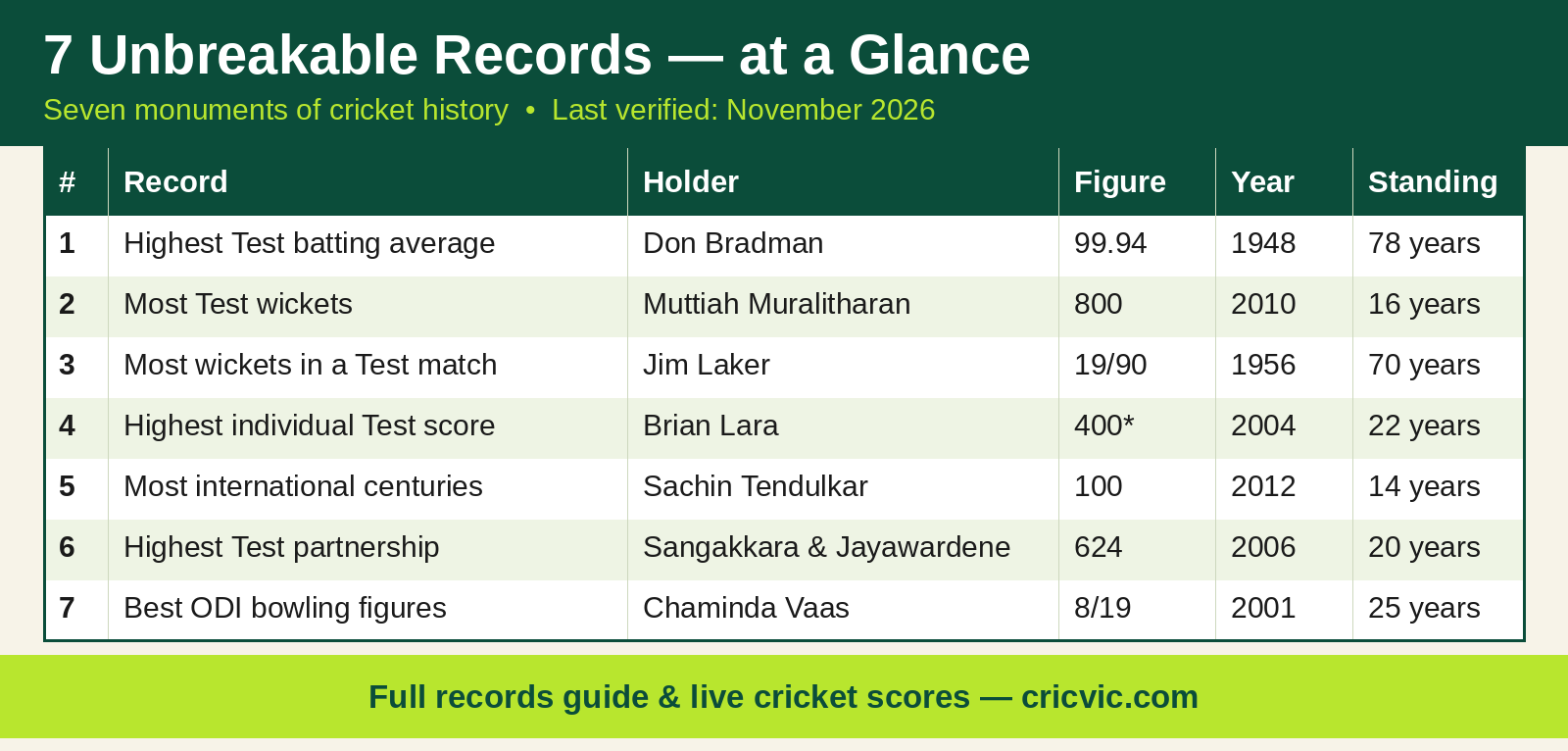
Cricket loves its numbers. Every season brings a new fastest fifty, a new highest chase, a new name on a leaderboard. Most records are borrowed — held for a while, then handed over. But a few were never really borrowed at all. They were carved in stone on the day they were set, and the decades since have only deepened the carving.
These seven are monuments. They have survived rule changes, format revolutions, covered pitches, white balls, DRS, T20, and generations of athletes fitter and better prepared than their setters ever were. Each one tells a story worth retelling — and each one has a reason it will almost certainly outlive us all.
Last verified: November 2026.
Don Bradman — 99.94: The Number Nobody Can Touch
It is the most famous decimal in sport. Don Bradman played 52 Test matches between 1928 and 1948, scored 6,996 runs, made 29 centuries — and finished with a batting average of 99.94. To grasp how absurd that is, consider the company below him: the next-best career averages in Test history sit in the low 60s. Not the 80s. Not the 70s. The low 60s. The gap between Bradman and the second-best batsman who ever lived is roughly the gap between that second-best batsman and a decent county professional.
The cruel poetry of it is that 100.00 was right there. In his final innings, at The Oval in 1948, Bradman needed just four runs to retire with a perfect average of one hundred. The crowd rose as he walked out. Eric Hollies bowled him a googly second ball. Duck. The 99.94 was sealed forever — and somehow, the near-miss made the legend bigger, not smaller.
Why it will stand: Modern batsmen play more cricket, on flatter pitches, with better bats and protective gear — and the best of them still average in the 50s and low 60s. A career average of 99.94 requires not just dominance but near-perfection sustained across two decades, in an era of uncovered pitches and no helmets. The game has changed too much, in too many ways, for anyone to get within thirty runs of it.
Muttiah Muralitharan — 800 Test Wickets: The Final Ball
Spin bowling's greatest career ended the way Hollywood would have scripted it. Muttiah Muralitharan — all wrist, all shoulder, all wriggle — took his 800th Test wicket with the very last ball he ever bowled in Test cricket, dismissing India's Pragyan Ojha at Galle in July 2010. Eight hundred wickets. No bowler in the history of the game has taken more, and no bowler is ever likely to.
The scale of the achievement hides in the arithmetic. A great fast bowler might play 100 Tests and take 400 wickets. Murali took double that. He bowled more overs, in more heat, on more turning tracks, with a more scrutinised action than anyone — and kept taking wickets into his late thirties, finishing as the only member of the 800 club.
Why it will stand: Test cricket is shrinking. Teams play fewer long-form matches than they did in Murali's era, workloads are managed more carefully, and the truly great spinners of the modern game retire with totals in the 400s and 500s. To reach 800, a bowler would need roughly 130-plus Tests of relentless output — a volume of cricket the modern calendar simply does not offer.
Jim Laker — 19 Wickets in a Match: A Day That Broke the Scorecard
Old Trafford, 1956, the fourth Ashes Test. What Jim Laker did over those days still reads like a misprint: 19 wickets for 90 runs — 9 for 37 in the first innings, all 10 for 53 in the second. Nineteen of the twenty Australian wickets to fall in the match belonged to one off-spinner. No bowler had taken 19 in a Test before. None has since, in seventy years of trying.
The conditions helped — a worn, dusty pitch on the final days — but conditions help everyone on the field, and only Laker turned them into immortality. His partner in crime, Tony Lock, took the single remaining wicket, which tells you everything about how completely Laker owned that game. The scorecard from Old Trafford remains the most lopsided bowling performance ever recorded at the highest level.
Why it will stand: Taking 19 wickets requires a near-perfect storm: a wearing pitch, a long match that goes deep, an attack built around one man, and an opposition that keeps getting out to him. Modern Tests are wrapped up faster, pitches are prepared to last five days, and bowling attacks share the spoils. Even the great hauls of the modern era — 16 wickets in a match — fall three short, which in this territory is a canyon.
Brian Lara — 400 Not Out: The Record He Lost and Stole Back
Records are usually set once. Brian Lara set the highest Test score, lost it, and then took it back — which might be the most Brian Lara thing ever. In 1994 he made 375 against England. In 2003, Australia's Matthew Hayden smashed 380 and took the crown. Six months later, Lara walked out in Antigua and simply refused to stop batting.
On 12 April 2004, against England, Lara batted for 582 balls, struck 43 fours and 4 sixes, and finished 400 not out — the only quadruple century in Test history. West Indies declared at 751 for 5, and the match drifted to a draw, but nobody remembers the result. They remember the man raising his bat, the record reclaimed, the sheer theatre of it.
Since then, the closest challengers have been Mahela Jayawardene's 374 in 2006 and Wiaan Mulder's 367 not out in 2025 — both magnificent, both still 26 or more runs short of 400. The quadruple hundred remains a one-man club.
Why it will stand: Scoring 400 requires everything to align: a flat pitch, a tiring attack, a team willing to let you bat on for two days, and a batsman with the concentration of a chess grandmaster and the appetite of a glutton. Modern Tests move faster — declarations come earlier, and the incentives of the World Test Championship punish the kind of marathon batting that 400 demands. Teams simply don't bat that long anymore.
Sachin Tendulkar — 100 International Centuries: The Mountain of Hundreds
A century in international cricket is a career-defining day. Sachin Tendulkar had one hundred of them. Fifty-one in Tests, forty-nine in one-day internationals — a combined mountain of hundreds built across 24 years, from a 16-year-old facing Wasim Akram to a 38-year-old carrying a nation's hopes.
The 100th arrived on 16 March 2012, against Bangladesh in Mirpur during the Asia Cup: 114 runs off 147 balls, the stadium on its feet, a country exhaling. And then the twist only cricket could write — India lost the match. Bangladesh chased down 293 for 5, and Tendulkar's greatest personal milestone came wrapped in a team defeat. It somehow made the achievement more human, not less.
One accuracy note, because the game has moved on: Virat Kohli has since passed Tendulkar's ODI mark and now holds 51 ODI centuries. But the combined hundred — and the 51 Test centuries — remain Tendulkar's alone. Nobody else has both halves of that mountain.
Why it will stand: A hundred international hundreds demands two things modern cricket rarely grants together: extraordinary longevity (two decades at the top) and relentless hundred-making across formats. Today's stars play more T20 cricket, where centuries are rare by design, and international careers are shorter and more fractured. Kohli's ODI record shows one half can be matched; the full hundred is a different mountain entirely.
Sangakkara & Jayawardene — 624 Runs: The Partnership That Refused to End
Some partnerships build innings. This one built a small civilisation. At the SSC in Colombo, from 27 to 29 July 2006, Sri Lanka were 14 for 2 against South Africa when Kumar Sangakkara joined Mahela Jayawardene. What followed was three days of batting so complete it broke a record that had stood for nine years — and set one that has now stood for twenty.
They were finally separated at 638, having added 624 runs for the third wicket — the highest partnership in Test history. Jayawardene made 374 off 572 balls; Sangakkara 287 off 457. The previous record, 576 by Sanath Jayasuriya and Roshan Mahanama in 1997, was itself a Sri Lankan landmark. Sri Lanka declared at 756 for 5 and won by an innings and 153 runs. South Africa, to their credit, just kept coming back for more.
Why it will stand: A 624-run stand needs two batsmen in the form of their lives, on the same days, against an attack that can't break through, on a pitch that doesn't deteriorate. It also needs a captain willing to let it run for the better part of three days. Modern cricket — with its result-oriented pitches, aggressive declarations, and packed schedules — rarely lets even one batsman bat that long, let alone two in perfect synchrony.
Chaminda Vaas — 8/19: The Only Eight-For in ODI History
One-day cricket has seen everything: 264s, hat-tricks of hat-tricks, last-ball sixes. But in more than fifty years of ODI cricket, only one bowler has ever taken eight wickets in an innings. On 8 December 2001, at the SSC in Colombo, Chaminda Vaas produced figures of 8 for 19 against Zimbabwe — and made it look inevitable.
Zimbabwe were bowled out for 38 in 15.4 overs, at the time the lowest ODI total ever recorded. Vaas's spell included a hat-trick — Stuart Carlisle, Craig Wishart and Tatenda Taibu falling in succession — and it broke the previous best ODI figures of 7 for 30, held by his own teammate Muralitharan. Left-arm swing, relentless accuracy, and a batting lineup with nowhere to hide.
Why it will stand: Eight wickets in a 50-over innings means dismissing 80 percent of the opposition almost single-handedly, before your teammates finish the job. Modern ODI batting is deeper and more aggressive — tailenders swing harder, and 50 overs now routinely produce 300-plus totals. Bowlers are also rotated more and rarely bowl their full ten overs in one devastating burst. Twenty-five years on, nobody has even taken a second eight-for to keep Vaas company.
What Makes a Record Truly Unbreakable?
Not every long-standing record is unbreakable — some are just waiting. So what separates the records above from the ones that will eventually fall? Four things, and every record on this list has at least three of them.
First, time. The longer a record survives, the more eras it has defeated. Bradman's 99.94 hasn't just survived the modern game; it survived the 60s, the 70s, the Packer revolution, and the T20 age. Each passing decade is another generation of challengers who tried and failed. Time is the record's bodyguard.
Second, era shifts. Several of these records belong to conditions that no longer exist. Laker's 19 came on uncovered, crumbling pitches in timeless-feeling Tests. Murali's 800 came from an era of 130-Test careers. Modern cricket — covered pitches, managed workloads, three-format calendars — doesn't just make these records hard to break; it makes the attempt structurally unlikely.
Third, opportunity scarcity. Some records require a door to open that rarely opens. To beat Lara's 400, you need a team willing to bat for two full days in an age of quick declarations. To beat the 624-run stand, you need two once-in-a-generation batsmen peaking simultaneously. The opportunity itself is the rarest part.
Fourth, the mental barrier. This is the least measurable and the most real. Once a number like 99.94 or 800 sits untouched for decades, it stops being a target and becomes folklore. Challengers aren't just playing the opposition; they're playing the weight of history. And history, in cricket, is a very good bowler.
Records that lack these protections — fastest hundreds, highest team totals, most sixes in a year — fall regularly, because the modern game actively rewards them. The seven above belong to a different category: they are protected not by luck, but by the structure of the sport itself.
Frequently Asked Questions
Which of these records is the oldest?
Jim Laker's 19 wickets in a Test match, set at Old Trafford in the 1956 Ashes, is the oldest — standing for 70 years. Bradman's average dates to 1948, but since it was completed at his retirement rather than in a single performance, Laker's single-match feat holds the "oldest unbroken record" distinction in the purest sense.
Has anyone ever come close to Bradman's 99.94?
No — and that is precisely the point. The next-best career averages in Test history are in the low 60s, a gap of nearly 40 runs per innings sustained over an entire career. Modern greats have peaked in the high 50s and low 60s. Nobody has mounted even a distant challenge, and the structure of the modern game makes one less likely, not more.
Why don't modern players break these records if they're fitter and better trained?
Fitness and preparation have improved enormously, but they serve the modern game — which is faster, shorter, and spread across three formats. These records were set in conditions the modern game has abolished: uncovered pitches, endless Test schedules, two-day batting marathons. Today's players are optimised for a different sport, in the ways that matter for these numbers.
Could T20 cricket ever produce an "unbreakable" record?
It is too early to tell, but the format works against it. T20 is young, still evolving tactically, and its records — fastest fifties, most sixes — keep falling as batting methods advance. An unbreakable record needs decades of failed challenges behind it. Check back in 2040.
Is Muralitharan's 800 safer than Bradman's 99.94?
They are safe in different ways. Bradman's average is safe because the gap is mathematical — nobody averages within 35 runs of it. Murali's 800 is safe because the opportunity is disappearing — bowlers don't play enough Tests anymore. If forced to pick the single safest record in cricket, most historians still choose 99.94: it is not just unbeaten, it is unapproached.
Which record is most likely to fall first, if any?
Honestly? None of them soon. But if one cracks, the smart money is on the 624-run partnership or Lara's 400 — both depend on batting-friendly conditions and long innings, which still occasionally occur. Even then, "most likely" here means "least impossible," not "probable."
The Bottom Line
Cricket will keep producing records. Every year, someone will score faster, hit further, or take more wickets in a season than anyone before. That is the game's lifeblood, and it is worth celebrating — you can follow the next would-be record-breakers ball by ball in live cricket matches.
But these seven are different. They are not waiting to be broken; they are waiting to be appreciated. Each one marks a moment when a player, a pair, or a team touched something close to perfection — and the decades since have only confirmed how far perfection sits from the rest of us.
Records are the game's memory. And some memories, it turns out, are permanent.
Want more cricket history? Read our complete guide to cricket's 42 Laws and the 73 rule changes of October 2026, explore the women's leagues that are writing their own record books, or check which clashes are coming up next in upcoming cricket matches — because the next monument might be built this week.