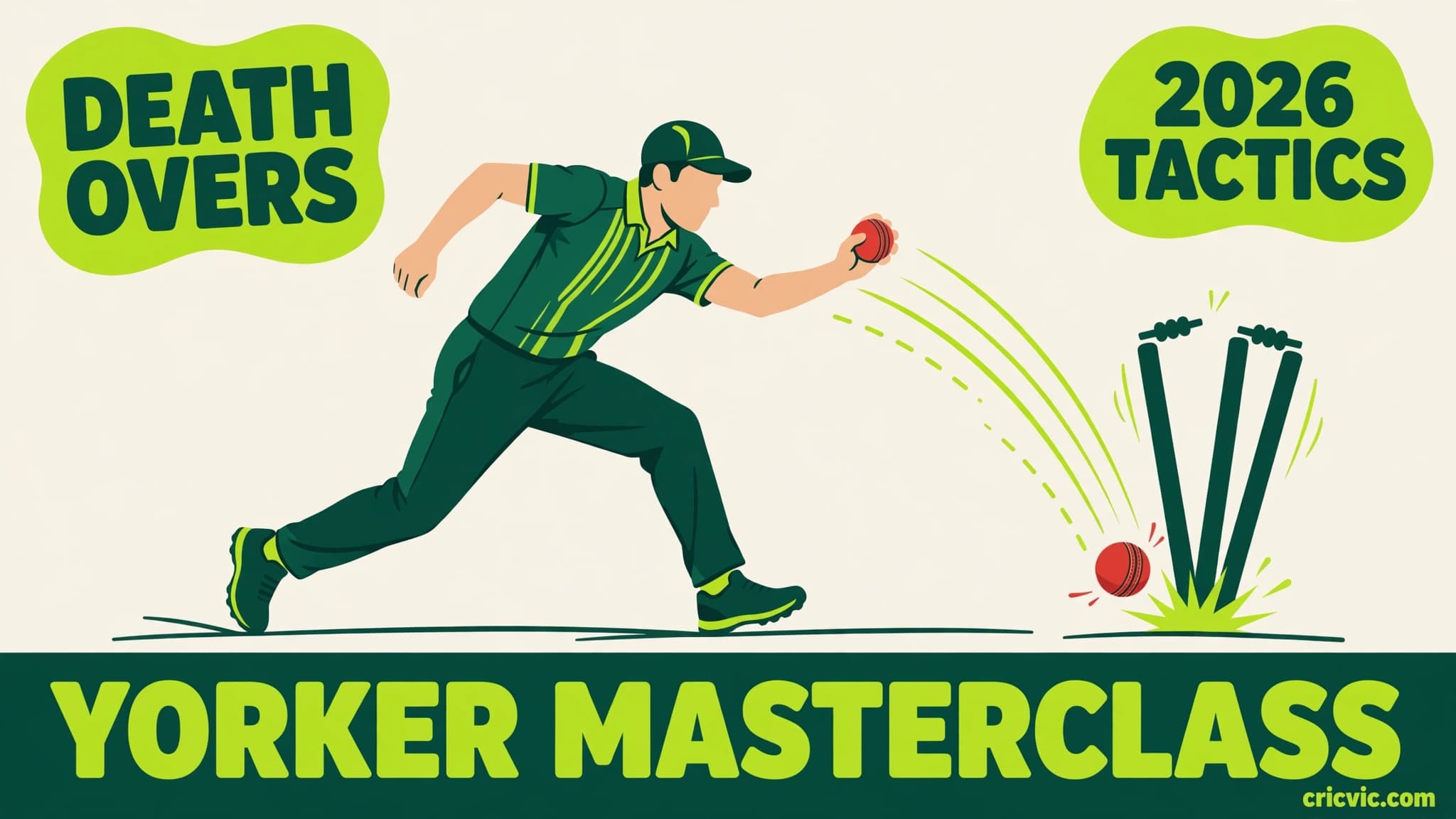
A T20 match is coasting. Fourteen overs gone, the batting side needs 60 off the last six — tense, but gettable. Then the captain throws the ball to his death specialist. Twenty-four deliveries later, the equation reads 18 off one over, then silence. That is what death bowling does. It turns a chase into a funeral.
This guide explains the art of bowling at the death — the yorker, its modern cousin the wide yorker, and the slower-ball tricks that make up a 2026 death bowler's playbook.
What Are Death Overs?
Death overs are the final stretch of a limited-overs innings — roughly overs 16 to 20 in a T20, and overs 45 to 50 in an ODI. The name is dramatic, but it fits: this is where matches are won and lost.
Everything about the death is different. The batters stop respecting good balls and start swinging at everything. Field restrictions are gone, so the fielding side can finally spread out — five fielders on the boundary in a T20. But even with all that protection, scoring rates in the death routinely touch 12 to 15 an over in modern cricket. The bowler's job is no longer to take wickets — it's to stop the bleeding. A death bowler who goes for 10 an over has done well. One who goes for 7 has been exceptional.
Why does this phase decide matches? Simple maths. In a T20, the last five overs are a quarter of the innings — and teams regularly score 30 to 40 percent of their total in them. Restrict those overs and you take 20 runs off the opposition's score. That is often the margin of victory.
The Yorker — Cricket's Most Feared Ball
A yorker is a delivery pitched right at the batter's feet — full length, landing at the base of the stumps. There is no harder ball to score off. The batter cannot get under it to launch it, cannot step back to cut it, and barely has time to squeeze the bat down in defence. At best, they jam it out for a single. At worst, their stumps are rearranged.
Few bowlers owned the yorker like Waqar Younis. The Pakistani great built a career on yorkers that came with late reverse swing — the ball bending in at the death, landing on the toes, then shattering the stumps. Batters didn't just fear getting out to Waqar's yorker; they feared facing it, because a 145-kph toe-crusher genuinely hurts when it hits your foot.
England's death specialist Chris Jordan has described how modern masters practice the craft. In an ECB session, he talked through his high-intensity drill: nine balls at full effort, with cones marking four targets — the wide yorker, the straight yorker, the leg-stump yorker (for batters backing away to the leg side), and a slower-ball length spot. His goal is to land roughly six yorkers and three slower balls out of every nine-ball set. In a match, he aims for about ten yorkers across two death overs. That is the standard: not one magic ball, but relentless repetition of the right length.
The yorker's genius is its simplicity. It doesn't need swing, seam, or pace. It just needs to be full. But that simplicity hides a razor-thin margin for error.
Is the Yorker Dead? The 2026 Debate
Here is the uncomfortable truth: cricket keeps asking whether the yorker still works. Average T20 team scores have climbed from around 157 in 2008 to roughly 180 by 2025 — the game has tilted sharply towards batters. The IPL's impact-player rule, introduced in 2023, deepened every batting line-up by letting teams effectively bat with twelve players. More batting depth means more licence to swing from ball one.
Coaches have noticed the yorker's shrinking margin. Deep Dasgupta has pointed out the geometry problem: a traditional yorker tails in towards middle and leg, and if the bowler misses by inches, the ball lands in the slot with the whole leg side vacant — a gift for any modern batter. Former India coach W V Raman put it more bluntly: there is very little room for error with toe-crushers, while the wide yorker at least lets you protect one side of the ground.
So no, the yorker isn't dead. But the straight yorker — the classic Waqar toe-crusher — has become the riskiest ball in the death bowler's kit. Modern batters are too good at punishing a yorker that drifts into the slot. That is why the art evolved, and why the wide yorker took over.
The Wide Yorker — The Modern Answer
The wide yorker is full length, but aimed wide outside the off stump, flirting with the tramline without crossing it into wide territory. It is the compromise that made the yorker survive.
Why does it work better in 2026? Two reasons:
1. The miss is safer. A straight yorker that goes wrong becomes a low full toss in the hitting zone. A wide yorker that goes slightly wrong is just... slightly wider, or slightly shorter — still out of the batter's comfortable hitting arc. The error margin is kinder.
2. It protects one side. With the ball wide of off stump, the bowler can stack fielders on the off side — deep point, long-off, third man — and dare the batter to hit against the line. Even a good connection usually finds a fielder.
When do bowlers use it? Almost by default now in the death, especially to batters who stay leg-side of the ball or shuffle across their stumps. The wide yorker says: you want to hit me? Reach for it.
The catch is execution. Push it an inch too wide and it's a wide — a free run plus an extra ball. Bowl it too short and it's a juicy cut shot. The wide yorker demands the same precision as the straight yorker, but the punishment for imperfection is milder. That trade-off is why it dominates modern death bowling.
The Slower-Ball Arsenal
If the yorker is about length, the slower ball is about deception. The bowler runs in with the same effort, the arm rotates at the same speed — and the ball arrives a fraction of a second later than the batter expects. The batter has already committed to the shot. The result: a mistimed heave, a skied catch, or a complete miss.
The main variations:
· Back-of-the-hand slower ball. The bowler flicks the ball out with the back of the hand facing the batter. It floats, dips, and can be very hard to pick.
· Off-cutter / leg-cutter. The bowler rolls the fingers across the seam at release, making the ball grip and turn slightly off the pitch — while arriving slower than a stock delivery.
· Knuckleball. The ball is gripped on the knuckles rather than the fingertips, killing the pace. It wobbles through the air with almost no rotation, like a baseball knuckleball.
· Slower yorker. The ultimate combination — full length and deception. The batter expects pace at their toes and gets a floater instead. When it works, it is unplayable.
The key to all of them is identical arm speed. A slower ball the batter reads early is just a juicy half-tracker. The great death bowlers — think Dwayne Bravo at his peak — sold every slower ball with the same run-up, the same leap, the same whip of the arm. The batter's eyes say fast; the ball says otherwise.
The Modern Death Plan
No single ball wins the death. The modern death bowler works from a plan built on three things:
1. Mix and sequence. A diet of only yorkers becomes predictable — batters start shuffling early or premeditating scoops. The best death spells alternate: wide yorker, wide yorker, then a slower ball into the pitch; or hard length, hard length, then the surprise full one. Unpredictability is the weapon.
2. Read the batter. Death batting is full of tells. A batter backing away to the leg side is opening the off side — follow them with the leg-stump yorker. A batter shuffling across to scoop wants the ball straight — go wide. A batter standing deep in the crease is buying time against pace — slip in the slower ball. Jordan's drill trains exactly this: four targets, because the batter's movement dictates the answer.
3. Set fields for the plan. Bowling wide yorkers? Stack the off side — deep point, sweeper, long-off — and leave the leg side relatively empty. You're conceding the single to protect the boundary. Bowling straight at the stumps? Keep midwicket and long-on back. The field and the ball must tell the same story; a wide yorker with no deep point is just a gamble.
And there is the ever-present risk: a yorker gone wrong becomes a low full toss. A full toss above waist height is a no-ball — a free hit in limited-overs cricket, the ultimate punishment. Every death bowler lives with this: the best ball in cricket is one inch away from the worst outcome.
How to Bowl a Yorker
For the club cricketer or the curious fan, here is the craft broken down:
Grip and seam. Hold the ball like a normal seam-up delivery, seam upright. The yorker doesn't need swing — it needs a straight seam and a clean release. Some bowlers angle the seam slightly towards fine leg to encourage late inswing, the Waqar way.
Release. The trick is releasing the ball later than you think — letting it go closer to the ground so the trajectory stays full. Most bowlers who miss their yorkers release too early, and the ball lands halfway down. Think "push it into the pitch at their toes," not "bowl it at the stumps."
Follow-through. Drive your body towards the target and finish low. A tall, upright follow-through tends to drag the length back. The best yorker bowlers almost crouch through the crease.
Practice template. Borrow Jordan's structure: mark four targets with cones — wide yorker, straight yorker, leg-stump yorker, slower-ball length. Bowl sets of nine at full intensity, aiming to hit six yorkers and three slower balls. Track your hit rate over weeks. In matches, the target is simple: ten good yorkers across your two death overs. You won't land all ten. But chasing the number builds the habit.
One warning from every coach: don't practise yorkers at half pace. The muscle memory of the release point only transfers if the intensity matches a match. Bowl them like you mean them, or don't bowl them at all.
FAQs
When are the death overs?
Roughly overs 16–20 in a T20 and overs 45–50 in an ODI — the final phase of a limited-overs innings, when batters attack hardest.
What's the difference between a yorker and a full toss?
A yorker pitches at the batter's feet (it bounces just in front of them); a full toss reaches the batter without bouncing at all. A yorker is legal and lethal; a full toss above waist height is a no-ball.
Why do bowlers bowl wide yorkers now?
Because the margin for error is kinder. A missed straight yorker becomes a slot ball with the leg side open; a missed wide yorker is usually still out of the hitting arc — and it lets the bowler protect one side of the field.
What is a slower ball?
A delivery bowled with the same arm speed but less pace — via back-of-the-hand, cutters, or the knuckleball grip — so the batter commits to the shot too early and mistimes it.
Who are the best death bowlers?
The modern pantheon includes Jasprit Bumrah, Trent Boult, and Chris Jordan; historically, Waqar Younis and Lasith Malinga defined the craft with their yorkers.
Can spinners bowl at the death?
Yes — and increasingly they do. Spinners use wide lines, variations in pace, and carrom balls or googlies to survive the death, especially when the pitch grips. It's harder, but the element of surprise counts for a lot.
Death overs decide matches — watch them unfold live. Follow the final overs ball by ball on cricvic.com's live scores, and find more guides on the blog.