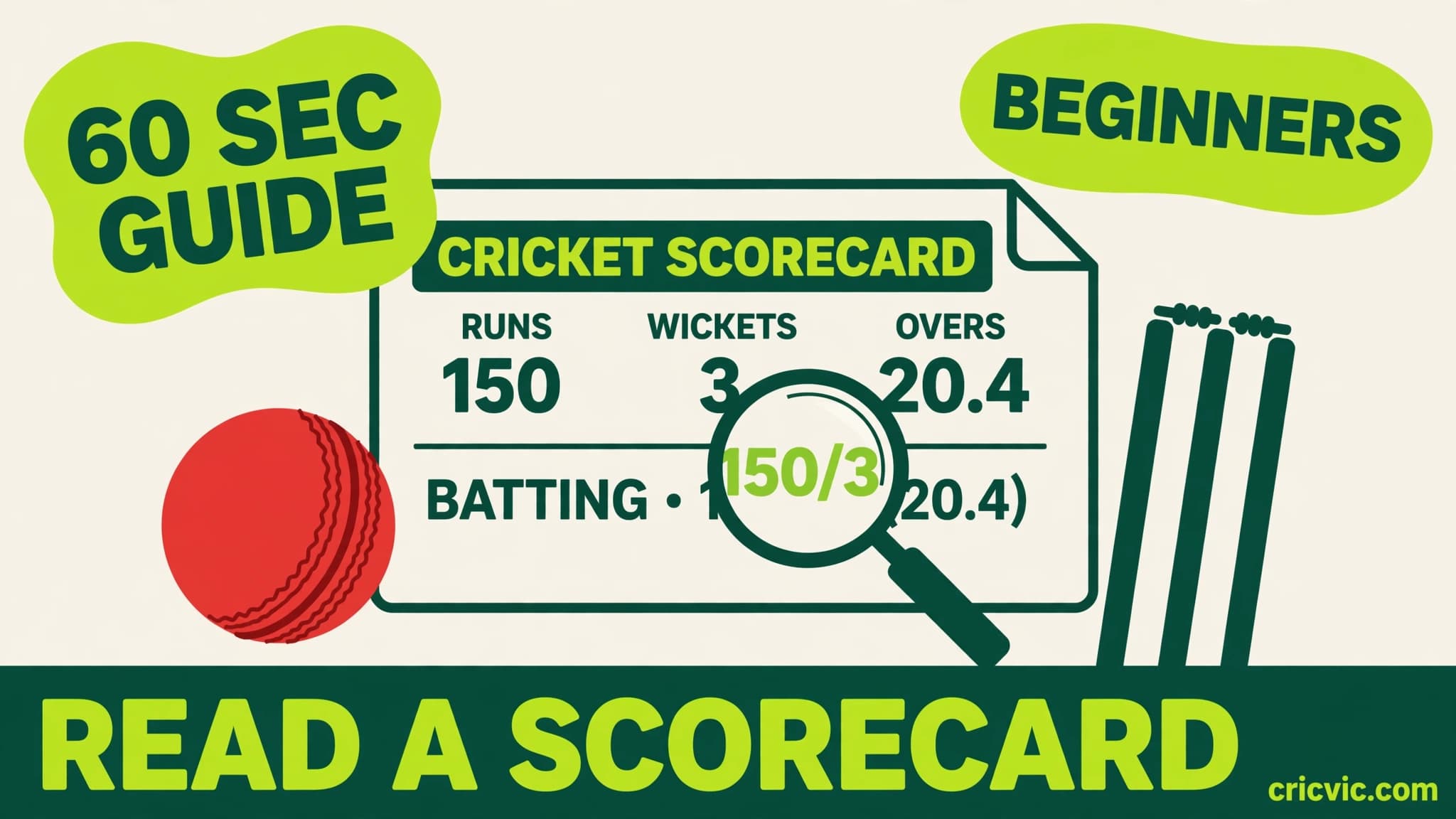
You've opened a live cricket page and seen something like PAK 165/3 (20 ov) and a wall of numbers underneath. It looks like a secret code. It's not. A cricket scorecard is actually one of the most efficient summaries in all of sport — once you know the shorthand, you can read an entire innings in under a minute. This guide teaches you how, line by line, with no prior knowledge assumed.
The One-Line Summary
Let's decode the most common thing you'll see: 165/3 (20 overs).
It means the team scored 165 runs and lost 3 wickets in 20 overs. That's it. The first number is always the runs; the second is wickets lost. (One quirk: in Australia, scorecards flip it — 3/165, wickets first. Same information, different order. England and India show runs first: 165/3.)
When you see a decimal, like 150/3 (20.4 overs), read it as 20 complete overs plus 4 balls of the 21st over. The decimal is a ball count, not a fraction — 20.4 does not mean "twenty point four overs." An over has six balls, so you'll only ever see .1 through .5.
Two more one-liners you'll meet constantly. 198 all out (47.2 overs) means the whole team was dismissed for 198 — all ten wickets gone, innings over early. And in a chase you'll see something like Need 40 off 24 balls — the target arithmetic spelled out: 40 runs required from 24 remaining deliveries, which is a required run rate of 10 per over. Once you can read those three lines, the rest of the scorecard is just supporting detail.
That one line tells you the score, the damage, and how far into the innings they are. Everything below it is the detail.
The Batting Card, Line by Line
Here's a realistic batting card from a T20 innings — Pakistan 165/3 off 20 overs:
Babar Azam — c Buttler b Archer — 42 (35) — 4s: 5, 6s: 1 — SR: 120.00
Mohammad Rizwan — b Rashid — 18 (22) — 4s: 2, 6s: 0 — SR: 81.81
Saim Ayub — run out (Buttler) — 31 (19) — 4s: 4, 6s: 1 — SR: 163.15
Fakhar Zaman — not out — 55* (38) — 4s: 6, 6s: 2 — SR: 144.73
Shadab Khan — DNB
Let's unpack the columns.
How out. The dismissal column is written in code. "c Buttler b Archer" means caught by Buttler, bowled by Archer — the bowler gets the wicket, the catcher gets the credit in parentheses. "b Rashid" means bowled by Rashid, no fielder involved. "run out (Buttler)" means Buttler's throw broke the stumps; notice no bowler is named, because a run out is never the bowler's wicket. "not out" means the batter was still batting when the innings ended — the star (*) next to the score marks it.
R (runs). Simply how many runs the batter scored. Fakhar's 55* is the top score here.
B (balls faced). How many deliveries the batter faced. This is the context that makes runs meaningful — 55 off 38 balls (Fakhar) is a very different innings from 55 off 90 balls.
4s and 6s. Boundaries. A 4 is a ball that reached the boundary rope; a 6 cleared it on the full. Fakhar hit 6 fours and 2 sixes — that's 36 of his 55 runs in boundaries. This tells you whether a batter accumulated or attacked.
SR (strike rate). Runs scored per 100 balls faced. Fakhar's 144.73 means he scored at roughly 1.45 runs per ball. In T20 cricket, anything above 140 is brisk, above 170 is explosive, and below 100 is a struggle. In Tests, nobody cares about strike rate — survival matters more than speed.
DNB — Did Not Bat. Shadab never got to the crease. In a completed 20-over innings with only 3 wickets down, the lower order simply wasn't needed.
One more dismissal you'll occasionally see: retired hurt. A batter who leaves injured can return later in the innings, unlike most other dismissals. It's the only "out" that isn't really out.
Try reading one full line end to end, the way you'll do it on a live page: "Fakhar Zaman — not out — 55* (38) — 4s: 6, 6s: 2 — SR: 144.73." That's: Fakhar is still batting, has 55 runs off 38 balls, hit six fours and two sixes, and is scoring at nearly 1.45 runs a ball. One line, whole story. Do that for every batter and you've read the innings.
The Bowling Card
Now the other side. Here's our example bowling card:
J. Archer — 4-0-32-2 — ECO: 8.00
A. Rashid — 4-0-28-1 — ECO: 7.00
S. Curran — 4-0-41-0 — ECO: 10.25
C. Jordan — 4-1-19-0 — ECO: 4.75
The figures read as O-M-R-W: Overs bowled, Maidens, Runs conceded, Wickets taken. So Archer's 4-0-32-2 means 4 overs, 0 maidens, 32 runs conceded, 2 wickets taken.
Maidens (M). An over in which no runs were scored off the bat — the batter survived six balls without scoring. Jordan's 4-1-19-0 includes a maiden, which in T20 cricket is genuinely remarkable. In Tests, maidens are routine; in T20s, they're events.
Economy rate (ECO). Runs conceded per over. Jordan's 4.75 is outstanding in a T20 (the team went at 8.25 overall); Curran's 10.25 is expensive. Economy is the bowler's equivalent of the batter's strike rate — the single number that sums up the spell.
Two things that surprise beginners. First, a run out is never credited to the bowler — Saim Ayub's run out appears nowhere in the bowling figures, because no bowler earned it. Second, byes and leg byes are not charged to the bowler either — they count against the team, not the bowler's figures. Only runs scored off the bat (plus wides and no-balls) go against the bowler.
And don't judge a spell by wickets alone. Jordan took zero wickets here, but 4-1-19-0 at an economy of 4.75 in a T20 is a match-shaping spell — he strangled the scoring while others took the wickets. Conversely, a bowler can take 3 wickets and still have bowled badly if they went for plenty. Read the economy alongside the wickets, always.
Extras Explained
Extras are runs nobody "earned" — they appear on their own line because they belong to the team, not to any batter. Our example innings had 15 extras:
· w — wides (6). A ball too wide for the batter to reach. Costs 1 run (or more, if the batters run extra).
· nb — no-balls (2). An illegal delivery — usually the bowler overstepping the crease. Costs 1 run, plus the next ball is a "free hit" in limited-overs cricket.
· b — byes (4). The ball beat both batter and wicketkeeper, and the batters ran.
· lb — leg byes (3). The ball hit the batter's body (not the bat) and they ran.
· pen — penalty runs. Awarded by the umpire for offences like ball-tampering or deliberate time-wasting. Rare, but they appear here when they happen.
Extras matter most in close games. Fifteen extras is nearly 10% of Pakistan's total — in a match decided by 5 runs, you'd look straight at the extras line and ask which side gave away more. Bowling coaches obsess over wides and no-balls for exactly this reason: they're free runs, and free runs lose tight matches.
On the team total line you'll see extras folded in: 165/3 already includes the 15 extras. The batters' individual scores add up to 150; the extras make up the rest. That's why the batting column never quite sums to the team total on its own — the extras line bridges the gap.
Fall of Wickets — Reading the Story
FoW shows the team score each time a wicket fell: 1-25, 2-99, 3-131. Read it as: the first wicket fell at 25, the second at 99, the third at 131.
This is where the scorecard becomes a story. Our example reads steadily: an early wicket, then two big partnerships (74 and 32 runs added between wickets). No panic.
Now compare a collapse: 1-12, 2-18, 3-19, 4-33, 5-41. Four wickets for 29 runs — that's a team in freefall. The gaps between wickets tell you everything: big gaps mean partnerships and control; tiny gaps mean chaos.
FoW is also how you spot the match's turning point. If a team was 2-140 and finished 165/3, the middle order never got going — the bowling side dragged it back. Learn to glance at FoW first, and you'll understand an innings in seconds.
One more trick: the gaps between FoW entries are partnerships. 1-25 to 2-99 means the second-wicket pair added 74 runs together. Big gaps, big partnerships, a team in control. So FoW doesn't just show wickets — it shows every stand that built the total.
Quick Abbreviations Cheat List
Keep this handy until the code becomes second nature:
· c — caught (c Buttler b Archer = caught by Buttler, bowled by Archer)
· b — bowled
· lbw — leg before wicket
· st — stumped (by the wicketkeeper)
· run out — wicket broken while batters were running (never the bowler's wicket)
· hit wicket — batter broke their own stumps
· \* — not out (batter was still in when the innings ended)
· DNB — did not bat
· retired hurt — batter left injured (may return)
· SR — strike rate (runs per 100 balls)
· ECO — economy rate (runs conceded per over)
· RRR — required run rate (what the chasing team needs per over)
· FoW — fall of wickets (score at each dismissal)
· M — maidens (in bowling figures, the second number)
· O-M-R-W — the bowling figure format: Overs, Maidens, Runs, Wickets
FAQs
What does 20.4 overs mean?
Twenty complete overs plus four balls of the 21st over. The decimal counts balls (1–5), never fractions — 20.4 is not "twenty point four" of anything.
What does the \* next to a score mean?
The batter was not out — still batting when the innings ended. 55* means 55 runs, unbeaten.
Does a run out count as the bowler's wicket?
No — never. Run outs are credited to the fielder (and the team), not to any bowler. You'll notice no bowler is named in a run-out dismissal.
Why do some scorecards show 3/150 and others 150/3?
Convention differs by country. Australia shows wickets first (3/150); England, India, and most of the world show runs first (150/3). Same information, different order.
What is a maiden over?
Six balls, no runs scored off the bat. The "M" in bowling figures (the second number in 4-1-19-0). Prized by bowlers, routine in Tests, rare in T20s.
What's the difference between byes and leg byes?
Byes: the ball passed everyone untouched and the batters ran. Leg byes: the ball hit the batter's body (not the bat — that would be runs) and they ran. Neither counts against the bowler.
Now read one live — open live scores on cricvic.com and follow a real match ball by ball. You'll be surprised how fast the code clicks.
New to cricket's language? Our 100-term glossary and complete guide to the 42 Laws will fill in the rest.