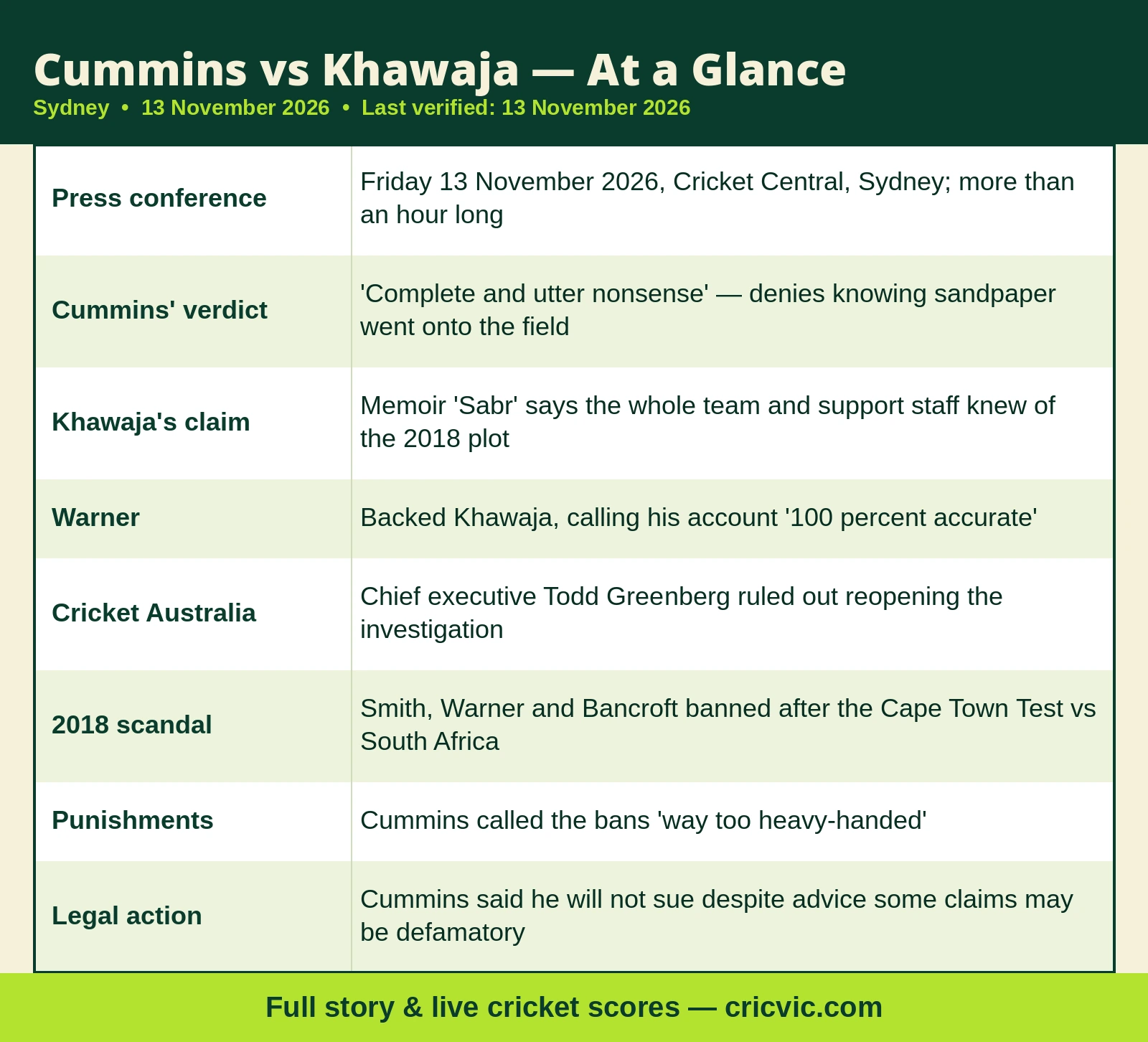
Pat Cummins has broken his silence on Usman Khawaja's explosive claims about the 2018 ball-tampering scandal, calling the allegation that the whole Australian team knew about the plot "complete and utter nonsense". The Australian Test captain held an extraordinary press conference at Cricket Central in Sydney on Friday, 13 November, speaking to reporters for more than an hour in a direct and emotional rebuttal of his former team-mate's account.
Cummins, 33, was playing his 13th Test when the Cape Town scandal unfolded in March 2018. Khawaja, who retired from international cricket earlier this year after 88 Tests, claims in his autobiography, Sabr, that the entire team and support staff knew sandpaper was being used to tamper with the ball — a claim David Warner has backed, calling Khawaja's account "100 percent accurate".
What Cummins said
Cummins did not hold back. He repeated the position he says he has held for eight years: he had no knowledge that sandpaper was being taken onto the field, and there was no plan to cheat.
When he says 'We all knew', if by that he means that we knew sandpaper was going out in the field, he's 100 per cent wrong. I've said that consistently for the last eight years. I did not know that was happening.
He said Khawaja's version of events went further than the claim that the team knew — it accused him and others of designing the plot, and that was the part he found hardest to accept.
But I think Usman actually says things that are actually far more serious than that. He says that I and others were architects of a scheme to ball tamper with sandpaper. That's complete and utter nonsense.
Cummins also revealed he had been shocked to learn from the book that Khawaja had warned Cameron Bancroft to be careful while using sandpaper in Cape Town — something he said was not the Khawaja he knew, and not the team-mate who would have stopped it happening there and then.
I was genuinely shocked this week when I found out that Usman admitted that he told Cam to be careful when using sandpaper (in Cape Town).
He spoke about the personal cost of the claims, saying Khawaja had been casual with the lives and reputations of his former team-mates.
Usman's a friend, but friends aren't casual with each other's lives and reputations. In his book, Uzzie has been casual with my life, and the lives of many others, and I think Australian cricket.
He made it clear he had said his piece and did not want to revisit the subject again.
I'll stay here until you have no more questions. I don't want to talk about this again after today.
The claims in Khawaja's book
Khawaja's memoir, Sabr, was published this week, and its account of the 2018 tour of South Africa has reopened one of the most damaging episodes in Australian cricket. Khawaja writes that knowledge of the ball-tampering plan was not limited to Steve Smith, David Warner and Cameron Bancroft — the three players who were punished — but extended to the whole team and support staff.
He has also alleged that sandpaper was used on the ball in the second Test of that series, in Port Elizabeth (now Gqeberha), on the edge of the field at the start of a session. Cummins said that claim was "news to me".
Khawaja has said he published his account to support the three players who received unprecedented and lengthy bans from Cricket Australia. Warner, for his part, has publicly backed his former opening partner, calling Khawaja's version "100 percent accurate".
There was no master plan, says Cummins
A central part of Cummins' argument was that there was no grand design behind what happened in Cape Town. He said the pressure to find reverse swing was intense during that series, and that teams at the time used all sorts of methods — legal and otherwise — to get the ball to move. But he insisted the step from legal methods to sandpaper was not planned in advance.
There was no master plan around using illegal methods. I think that's maybe something that hasn't been spoken about enough. People assume you've gone from very legal methods to suddenly taking sandpaper (on the field) and there must have been some huge master plan. The truth is that is not the case … there was no grand plan. There was no team meeting. There was no bowlers saying, 'this is what must happen'.
He added that at no time did he hear anyone propose an illegal method before going out onto the field.
Cummins also spoke about what he had seen over the years. He said the use of sandpaper on training balls — along with rubbing them on concrete or using a Stanley knife — was common in the nets to simulate natural reverse swing. And he said the only time he had witnessed illegal tampering in a match he was playing in was in a Sheffield Shield game, when a senior New South Wales team-mate took a bottle cap onto the field. The umpires dealt with it on the spot, he said, and it was the only such incident he had ever seen on the field.
He was also frank about the punishments handed out in 2018, calling the bans on Smith, Warner and Bancroft "way too heavy-handed".
What happened in Cape Town in 2018
The scandal erupted during the third Test against South Africa at Newlands in Cape Town in March 2018, when Bancroft was caught on camera using sandpaper on the ball. Smith, Warner and Bancroft were all banned by Cricket Australia, and the affair became known around the world as Sandpapergate.
Cummins, Mitchell Starc, Josh Hazlewood and Nathan Lyon issued a joint statement in 2021 denying any prior knowledge of the plan, saying they did not know a foreign substance had been taken onto the field until they saw the images on the big screen at Newlands. Cummins repeated that position again on Friday.
Cricket Australia's position
Cricket Australia chief executive Todd Greenberg told radio station SEN earlier this week that the organisation would not reopen its investigation into the 2018 affair. Cummins said it was "up to CA" whether another investigation was worthwhile, but he defended the original inquiry, saying it was the proper way to deal with the matter and that he had answered every question put to him fairly.
He also said he would not take legal action against Khawaja, despite being advised that some of the things said about him were probably defamatory.
A culture Cummins says he has changed
Cummins did not pretend the 2018 team was without fault. He conceded the side "had a win at all costs mentality, had an ugly underbelly, and there was too many silos within the team", and said he had spent his five years as captain working hard to eradicate those elements. The way the team acted on the field back then — abrasive, arrogant at times, disrespectful to umpires and opponents — did not sit well with him even as a young player, he said, and he believes the current Australian team has been "absolutely brilliant since 2018".
What happens next
Cummins has drawn a line under the subject, at least publicly, saying he does not want to talk about it again after today. Cricket Australia has already made its position clear: the investigation stays closed. But with Khawaja's book out, Warner backing his account, and the captain now on the record in the strongest terms, the debate is unlikely to disappear overnight. The press conference came on the same day Australia open their home season against England in the first ODI in Perth — a series Cummins is not part of, with the white-ball side led in his absence.
FAQs
What did Pat Cummins say about Usman Khawaja's claims?
Cummins called the claims "complete and utter nonsense" and "100 per cent wrong". He said he did not know sandpaper was being taken onto the field in Cape Town, and denied that he or others were architects of a scheme to tamper with the ball.
What does Khawaja claim in his book Sabr?
Khawaja claims the entire Australian team and support staff knew about the ball-tampering plan during the 2018 tour of South Africa, and that sandpaper was also used in the second Test in Port Elizabeth. David Warner has backed his account, calling it "100 percent accurate".
Will Cricket Australia reopen the investigation into Sandpapergate?
No. Chief executive Todd Greenberg said earlier this week that there is no compelling reason to revisit the 2018 investigation, and Cummins said the decision was up to Cricket Australia.
What happened in the 2018 ball-tampering scandal?
During the third Test against South Africa at Newlands, Cape Town, in March 2018, Cameron Bancroft was caught using sandpaper on the ball. Steve Smith, David Warner and Bancroft were all banned by Cricket Australia.
Will Cummins take legal action against Khawaja?
No. Cummins said he had been advised that some of the things said about him were probably defamatory, but he would not be taking legal action.
Conclusion
Eight years after Cape Town, the sandpaper scandal still has the power to divide Australian cricket. Khawaja's memoir has put the whole team back under the microscope, and Cummins has now answered in the bluntest possible terms — no knowledge, no master plan, and no more to say. Whether that finally closes the argument, or simply opens a new chapter in it, will depend on what Khawaja, Warner and the others say next.
Also on CricVic: Cricket Australia Rules Out Fresh Investigation Into 2018 Ball-Tampering Scandal After Khawaja Memoir Claims
Sources: Cricket Australia — Cummins dismisses Khawaja's ball-tampering claims, Cricbuzz — 'Complete and utter nonsense' - Cummins hits back at Khawaja's sandpaper claims, The Week — '100% wrong': Pat Cummins slams Usman Khawaja's sandpaper scandal allegations