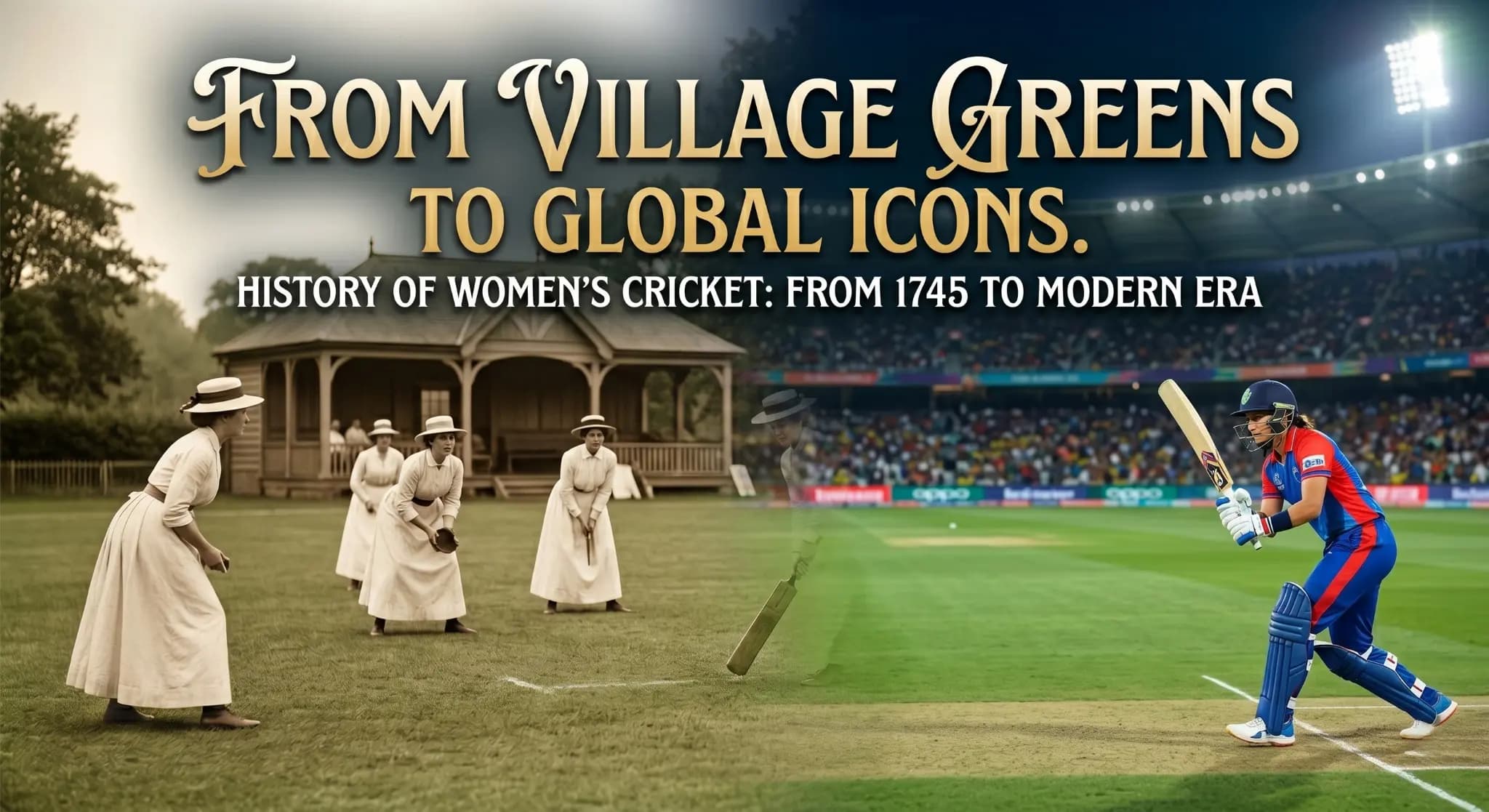
The journey of women's cricket is a remarkable story of resilience, skill, and steady growth. While many people view the rise of the women’s game as a recent phenomenon linked to modern T20 leagues, its roots go back centuries.
From informal matches played on English village greens to high-stakes international finals in packed stadiums, the evolution of this sport has been nothing short of extraordinary.
Today, women's cricket stands as a global powerhouse, breaking viewership records and establishing itself as a premier professional sport. Understanding its history is essential to appreciating the heights it has reached today.
2. The Early Origins (1745 – 19th Century)
The history of women playing cricket is almost as old as the game itself. The first recorded match took place on July 26, 1745, in Surrey, England.
This historic contest was played between the villages of Bramley and Hambledon.
According to reports from that time, the women were dressed in white and the match was conducted with great competitive spirit, signaling that the sport was more than just a passing hobby.
Throughout the 1800s, the game continued to spread across England and its colonies. However, it was often played in a social context rather than a professional one.
A major turning point arrived in 1887 with the formation of the White Heather Club in Yorkshire. This was the first dedicated cricket club for women, providing a structured environment for players to develop their skills.
By the end of the 19th century, women’s cricket had moved from occasional village festivities to a more organized activity, setting the stage for international competition.
3. Entering the International Arena (1934 – 1950s)
The transition from club cricket to the international stage was a defining moment for the sport. In December 1934, the first-ever Women’s Test match was played between England and Australia.
This historic tour, which took place in Australia, proved that women cricketers possessed the technique and stamina required for the longest format of the game. England emerged victorious in that inaugural series, but more importantly, the matches established a lasting rivalry that remains central to the sport today.
Following the success of the 1930s, New Zealand joined the international fold in 1935, playing their first match against England. Although World War II caused a temporary halt to global sports, women’s cricket saw a steady recovery in the late 1940s and 1950s.
As travel became easier, more nations began to express interest in formalizing their women's teams, leading to a broader global footprint for the game.
4. The Formation of Governance (1958 – 2005)
As the number of playing nations grew, the need for a central governing body became clear. In 1958, the International Women’s Cricket Council (IWCC) was formed to coordinate international tours and standardize the rules of the game.
Under the guidance of the IWCC, the sport reached a historic milestone in 1973—the inaugural Women’s Cricket World Cup. Notably, this tournament took place two years before the first Men’s World Cup, showcasing the forward-thinking nature of the women’s cricket community.
For several decades, the IWCC managed the game independently. However, a major shift occurred in 2005 when the IWCC merged with the International Cricket Council (ICC).
This integration was a game-changer, as it provided women’s cricket with access to better funding, superior training facilities, and more extensive media coverage.
This move marked the beginning of the professional era, transforming the sport from a dedicated amateur pursuit into a viable career path for female athletes.
5. The Modern Transformation & Professionalism
The introduction of the T20 format acted as a massive catalyst for the growth of the women’s game. This shorter, faster version of cricket brought in a new audience and significantly increased viewership figures.
As the game became more marketable, cricket boards began offering central contracts to female players. This shift meant that cricketers could finally focus on their skills full-time rather than balancing sports with other jobs.
Furthermore, the push for gender equality has led to significant changes in tournament structures. The ICC has made major strides in closing the gap by announcing equal prize money for men’s and women’s teams in global events.
This professional environment has raised the standard of play, with athletes now benefiting from elite coaching, advanced data analytics, and world-class fitness programs.
6. Regional Growth: The Global Spread
While England and Australia were the early leaders, women’s cricket has seen phenomenal growth across Asia, Africa, and the Caribbean.
In Asia, India and Pakistan have produced world-class talent despite facing various social and structural challenges in the early years. The passion for the game in these regions has turned players into household names and inspired a new generation of girls to pick up the bat.
South Africa has also emerged as a powerhouse, consistently performing well on the world stage. Meanwhile, the West Indies brought their unique flair to the game, winning the T20 World Cup in 2016 and proving that dominance is no longer restricted to just a few nations.
This global expansion has made international competitions more unpredictable and exciting, as teams from different continents now compete on equal footing.
7. International Debut Timeline (Major Nations)
The expansion of women’s cricket can be tracked through the years as different nations stepped onto the international stage. Below is a timeline of when major cricketing countries played their first official international match:
England: 1934 (Test debut vs Australia)
Australia: 1934 (Test debut vs England)
New Zealand: 1935 (Test debut vs England)
South Africa: 1960 (Test debut vs England)
India: 1976 (Test debut vs West Indies)
West Indies: 1976 (Test debut vs India)
Ireland: 1987 (ODI debut vs Australia)
Pakistan: 1997 (ODI debut vs New Zealand)
Sri Lanka: 1997 (ODI debut vs Netherlands)
Bangladesh: 2011 (Awarded ODI status)
8. Legendary Captains and Their Eras
Leadership has played a vital role in shaping the identity of national teams. Certain captains did more than just win games; they defined entire eras of the sport. Here are some of the most influential leaders in women’s cricket history:
Belinda Clark (Australia, 1994–2005):
A pioneer who led Australia to two World Cup titles. She was the first player (male or female) to score a double century in an ODI.
Mithali Raj (India, 2004–2022):
The longest-serving captain in the game’s history. Her leadership spanned nearly two decades, taking India to two World Cup finals.
Charlotte Edwards (England, 2006–2016):
She was the face of English cricket for ten years, leading her side to both T20 and ODI World Cup glory in 2009.
Sana Mir (Pakistan, 2009–2017):
A transformative figure for Pakistan cricket, she led the team through its most successful transition period and became the top-ranked ODI bowler under her own captaincy.
Meg Lanning (Australia, 2014–2023):
Known as "The Megastar," she led one of the most dominant eras in sports history, winning five ICC trophies as captain.
· 9. Current Standing: ICC Women’s Team Rankings
· To understand where the game stands today, looking at the official ICC rankings is essential. As of April 2026, the competitive landscape shows a mix of traditional powerhouses and rapidly improving nations.
Australia continues to set the benchmark across all formats, but the gap is narrowing as other countries invest more in their domestic structures.
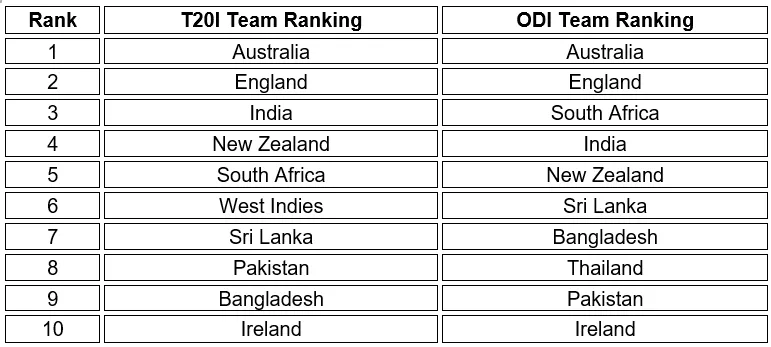
· These rankings highlight the global nature of the modern game. Emerging teams like Thailand and Sri Lanka have shown that with consistent participation, they can compete with the world's best, making every international series highly competitive.
· 10. From Village Greens to Global Icons
· The transformation of women’s cricket from 1745 to the present day is a testament to the passion and persistence of the players.
What started as a local pastime in English villages has evolved into a high-octane professional sport with a massive global following.
The journey involved overcoming social barriers, financial hurdles, and a lack of media representation, yet the sport has emerged stronger than ever.
· Today, women cricketers are global icons, recognized for their skill and athleticism on the same level as their male counterparts.
With the rise of lucrative leagues, equal prize money, and increasing broadcast reach, the future of the game looks incredibly bright.
This is not just the end of a long historical journey, but the beginning of a new golden age where women’s cricket continues to break boundaries and set new standards for excellence.