The landscape of women’s cricket has undergone a massive shift over the last decade. While international matches were once the only way to see top talent, the rise of franchise-based T20 leagues has redefined the sport.
These leagues have brought much-needed investment, professional standards, and global media attention to the game. No longer just a supporting act, women’s franchise cricket is now a standalone powerhouse that attracts millions of viewers and provides a sustainable career path for athletes worldwide.
1. The Catalyst: How T20 Changed the Landscape
The introduction of the T20 format was the spark that ignited the modern revolution in women’s sports. Its fast-paced nature and shorter duration made it perfect for broadcasters and stadium audiences alike.
Click Here To Watch Upcoming Cricket Matches
This format allowed players to showcase their power-hitting and innovative bowling skills, moving the game away from its traditional roots toward a more aggressive style.
As viewership grew, cricket boards realized that fans were eager for more high-intensity action, leading to the creation of domestic tournaments that mirror the success of men's franchise leagues.
2. Women’s Big Bash League (WBBL): The Pioneer
The Women’s Big Bash League in Australia stands as the original blueprint for successful female franchise sports. Launched in the 2015-16 season, it was the first league to move away from being a mere curtain-raiser for men’s matches and established itself as a standalone prime-time event.
By offering high-quality cricket and a professional environment, the WBBL set a high standard for domestic structures globally.
The success of the WBBL lies in its ability to integrate international stars with local talent. This exposure has not only strengthened the Australian national team but has also improved the skill levels of players from smaller cricketing nations who participate in the tournament.
Today, it remains a favorite for fans due to its competitive balance and the high level of athleticism on display.
3. The Women’s Premier League (WPL): The Game Changer
If the WBBL was the pioneer, the Women’s Premier League (WPL) in India is the ultimate game-changer. Since its debut in 2023, the WPL has injected an unprecedented amount of financial investment into the sport.
The massive auction prices and lucrative broadcasting deals have transformed the lives of many cricketers overnight, making it the most valuable women's sports league in the world after the WNBA.
Beyond the money, the WPL has provided a massive platform in a cricket-crazy nation, leading to record-breaking stadium attendances and digital viewership.
It has bridged the gap between domestic and international cricket in India, allowing young, uncapped players to learn directly from global legends.
The arrival of the WPL has signaled to the world that women’s franchise cricket is now a top-tier commercial entity capable of sustained economic growth.
4. The Hundred (Women) & WCPL: Diversifying the Game
The United Kingdom introduced a fresh perspective with The Hundred. This 100-ball format was designed to be simple and fast, specifically aimed at bringing new families and younger fans into the stadiums.
A significant part of its success has been the equal branding and double-header matches, where women’s and men’s teams share the same stage. This has led to massive attendance records in England, proving that the demand for the women's game is at an all-time high.
Similarly, the Women’s Caribbean Premier League (WCPL) has brought the vibrant energy of West Indies cricket to the franchise world. By providing local Caribbean players the chance to compete alongside international icons, the WCPL is helping to revive the sport in a region with a rich cricketing history.
These tournaments show that the league model is not just for big markets like India or Australia but is a global trend that works across different cultures.
5. Comprehensive Guide: Major Leagues, Seasons, and Formats
Understanding the structure of these leagues is key to following the global cricket calendar. Each league has its own unique system and "window" during the year. Here is a breakdown of the major tournaments:
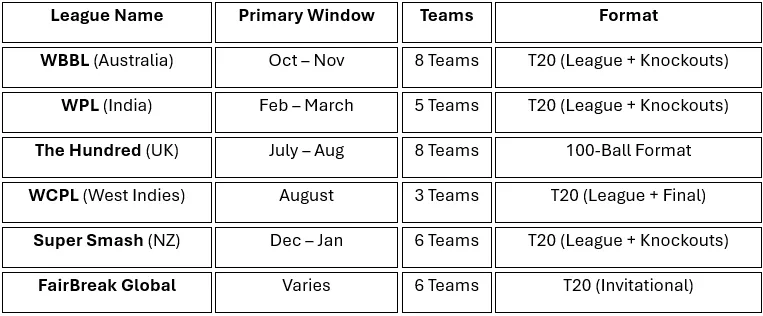
Most of these leagues follow a round-robin format where every team plays each other at least once, followed by playoffs or a direct final. The "window" system ensures that top international stars can travel from one league to another, creating a year-round cycle of professional cricket.
6. Upcoming Schedule: Women’s Leagues Through December 2026
For fans and analysts, the second half of 2026 is packed with high-energy franchise action. As the international calendar adjusts to accommodate these growing leagues, here is what to look for between now and the end of the year:
The Hundred (Women’s): July – August 2026
The UK-based 100-ball tournament will take center stage during the English summer, featuring eight city-based teams and the world's best all-rounders.
Women’s Caribbean Premier League (WCPL)
August 2026 Immediately following the UK season, the action moves to the Caribbean for a fast-paced tournament known for its festive atmosphere and spin-friendly tracks.
Women’s Big Bash League (WBBL 12)
October – November 2026 The most established league returns for its 12th edition. This window is often considered the peak of the domestic season, with Australia’s top stars returning to their home franchises.
Super Smash (Women’s)
December 2026 – January 2027 New Zealand’s premier T20 competition will kick off its festive season matches in December, providing a platform for Kiwi talent to shine alongside international recruits.
7. Impact on National Teams and Talent Pipelines
The most significant benefit of these leagues is the rapid development of young talent. Previously, a young player might jump from domestic regional cricket straight into the pressure of international matches. Now, leagues like the WPL and WBBL act as a finishing school.
When an uncapped 19-year-old shares a dressing room with legends like Sophie Devine or Harmanpreet Kaur, her learning curve is fast-tracked.
They learn how to handle big crowds, deal with intense media pressure, and understand the tactical nuances of the T20 game.
This has led to "national talent pipelines" becoming much stronger; teams are now finding ready-made stars who are prepared for the international stage from day one.
Consequently, the gap between the top-ranked nations and the rest of the world is slowly beginning to close.
8. Professionalism and Central Contracts
The expansion of franchise leagues has forced a total rethink of how national boards handle player contracts. In the past, many female cricketers were only paid during active tours, forcing them to maintain secondary jobs.
Today, the success of tournaments like the WBBL and WPL has pushed boards to offer lucrative central contracts that provide year-round financial security.
Professionalism now extends far beyond the paycheck. Players have access to full-time physiotherapists, strength and conditioning coaches, and mental health experts—standards that were once reserved only for the men’s teams.
This structured environment allows athletes to focus entirely on their performance, leading to a much higher level of fitness and skill on the field. For the first time in history, a young girl can look at cricket and see it as a viable, full-time professional career path.
9. The Financial Growth: Broadcasting and Sponsorships
The commercial value of women’s cricket has skyrocketed due to massive interest from broadcasters and global brands. In 2023, the broadcasting rights for the WPL were sold for a staggering amount, signaling that media houses see women’s sports as a high-growth asset.
Brands that once ignored the female side of the sport are now competing for jersey sponsorships and athlete endorsements.
Television viewership and digital streaming numbers for league finals have started to rival established men's sports. This surge in popularity is driven by the fact that the product on the field is genuinely exciting and high-scoring.
As these leagues become more profitable, the revenue is being reinvested into grassroots programs, creating a self-sustaining cycle of economic growth. The transition from a cost-center to a profit-making entity is perhaps the most significant victory for the sport in recent years.
10. Challenges and Future Expansion
Despite the massive success, the growth of franchise leagues brings its own set of challenges. One of the biggest concerns is "calendar congestion."
As more countries launch their own tournaments, such as the upcoming Pakistan Super League (PSL) women’s exhibition and full league plans, finding a window that doesn't clash with international duties is becoming difficult.
This often forces players to choose between representing their country or fulfilling a lucrative league contract.
Workload management is another critical issue. Playing high-intensity T20 cricket year-round across different continents can lead to burnout and injuries.
Furthermore, while the top leagues are thriving, there is still a need to ensure that the wealth and professional standards trickle down to smaller cricketing nations.
The goal for the next few years is to create a balanced global schedule that allows both international and franchise cricket to grow without compromising player health.
11. Beyond the Boundary: The Future of Franchise Cricket
The future of women’s cricket is undeniably tied to the success of its franchises. We are moving toward a world where franchise cricket might become the primary format, similar to how football operates globally.
There is already talk of expanding the number of teams in the WPL and the potential for a "Champions League" style tournament where the winners of the WBBL, WPL, and The Hundred compete against each other.
The league era is the best thing to have happened to women’s sports. It has provided a stage for talent, a reason for investment, and a source of inspiration for millions.
As boundaries continue to be pushed and records continue to be broken, the message is clear: women's franchise cricket is no longer just an "alternative" to the men's game; it is a premier global entertainment product in its own right.
The journey has just begun, and the next decade promises even more growth, glamour, and world-class action.