The United States cricket team is no longer a team of strangers. After the breakthrough of the 2024 T20 World Cup, the League 2 title in October 2026, and a second T20 World Cup appearance in 2026, the USA now has a recognisable core of players, a clear captain, and a pathway that runs from local leagues to Major League Cricket and then to the national team.
This guide brings together the USA cricket team players and squad in one place. It explains who leads the team, who bats, who bowls, who keeps wicket, which players are emerging, how the squad changes between formats, and how a player actually qualifies to represent the United States. Where a fact could not be verified, this guide says so, rather than guessing.
Introduction
If you follow USA cricket, you will quickly notice two things. First, the same names keep appearing: Monank Patel, Saurabh Netravalkar, Ali Khan, Harmeet Singh, Andries Gous and Saiteja Mukkamalla. Second, the squad is not fixed. A T20 World Cup squad, an ODI tri-series squad and a League 2 squad are not identical, because different formats, conditions and selection windows demand different combinations.
That is why this guide does not pretend that one list is the permanent USA squad. Instead, it gives you the latest major squads, explains each player's role, and separates current players from former core players. It is the companion to the main USA cricket team guide, which covers history, records and the team's journey in full.
Current Squad Overview
The USA men's team is led by Monank Patel, who captains the side in both ODI and T20I cricket. His deputy in the 2026 T20 World Cup squad was Jessy Singh, while Saiteja Mukkamalla served as vice-captain in the October 2026 ODI tri-series squad. That difference is a good example of how leadership roles can change from one series to another, even when the captain stays the same.
The head coach, as named by the ICC for the 2026 T20 World Cup, was Pubudu Dassanayake. He spoke before that tournament about a training camp in Sri Lanka, where the team worked on adapting to subcontinental conditions, and described the World Cup squad as strong and balanced across departments.
In broad terms, the USA squad is built around three pillars. There is an experienced batting core, led by the captain and supported by players who have played domestic cricket in India, South Africa or Sri Lanka before moving to the United States. There is a pace attack led by Netravalkar and Ali Khan. And there is a spin group built around Kenjige and Harmeet Singh, with all-rounders filling the gaps in between.
The squad also reflects how American cricket has grown. Some players were born in the United States. Others moved to the country, built a domestic career through Minor League Cricket and Major League Cricket, and then became eligible under ICC residency rules. That mix is now a normal part of USA cricket, not an exception.
The Latest Major Squads
Because squads change by series, the two most useful reference squads are the 2026 T20 World Cup squad and the October 2026 ODI tri-series squad. Both are listed here in full, so you can see exactly who was in each, and where they differ.
2026 T20 World Cup Squad
The ICC announced the following 15-player squad for the 2026 ICC Men's T20 World Cup, led by Monank Patel. Ten of the fifteen had also represented the USA at the 2024 T20 World Cup, which gave the squad valuable continuity.
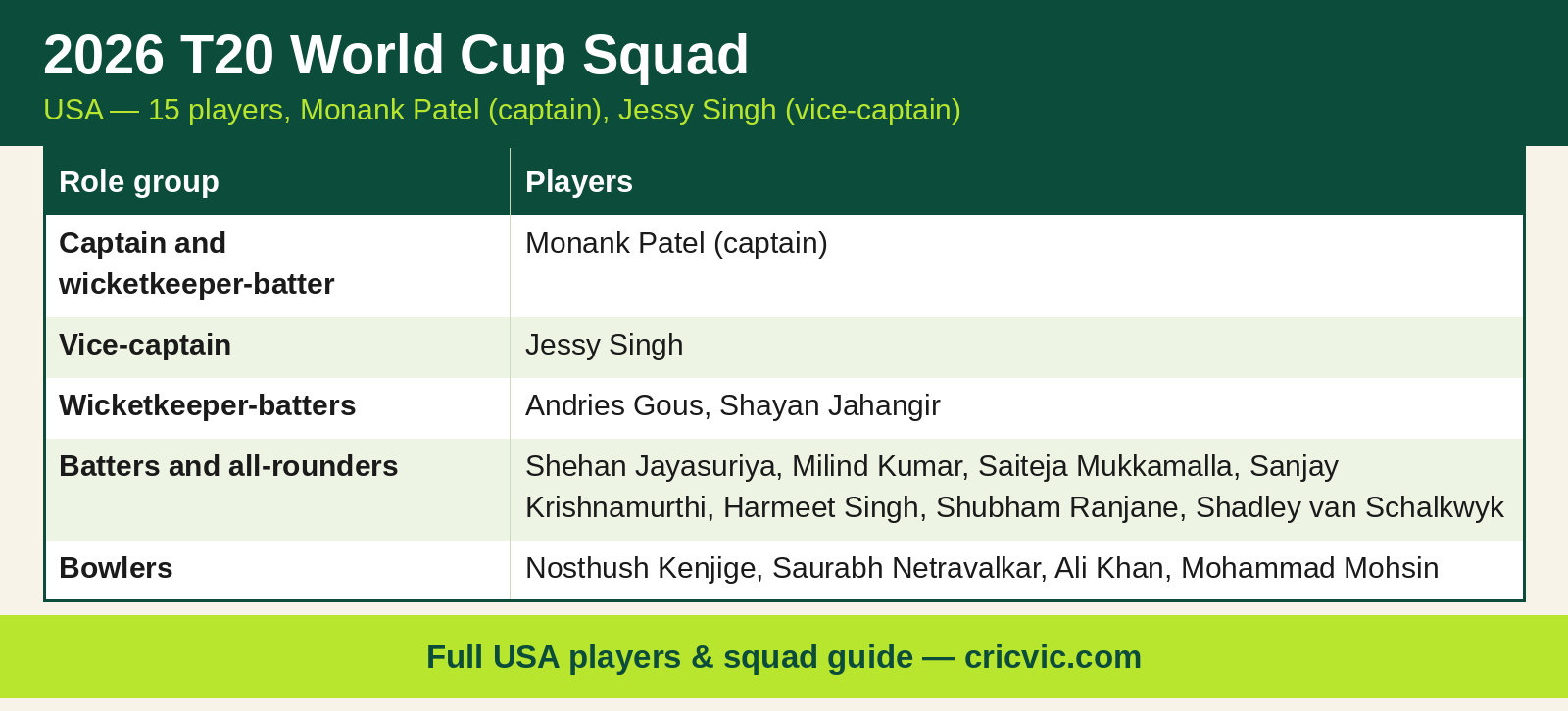
The squad was placed in Group A, alongside India, Pakistan, Namibia and the Netherlands. The USA finished that tournament with two wins from four matches, beating the Netherlands by 93 runs and Namibia by 31 runs, both in Chennai, and losing to India and Pakistan. Those results were covered in detail in the main USA team guide.
October 2026 ODI Tri-Series Squad
The ODI squad announced for the tri-series in October 2026 was different in several places, which is normal for a 50-over squad. It included Smit Patel, Ehsan Adil, Yasir Mohammad and Jasdeep Singh, who were not in the T20 World Cup fifteen, while Jessy Singh, Andries Gous and Mohammad Mohsin were not in this ODI list.
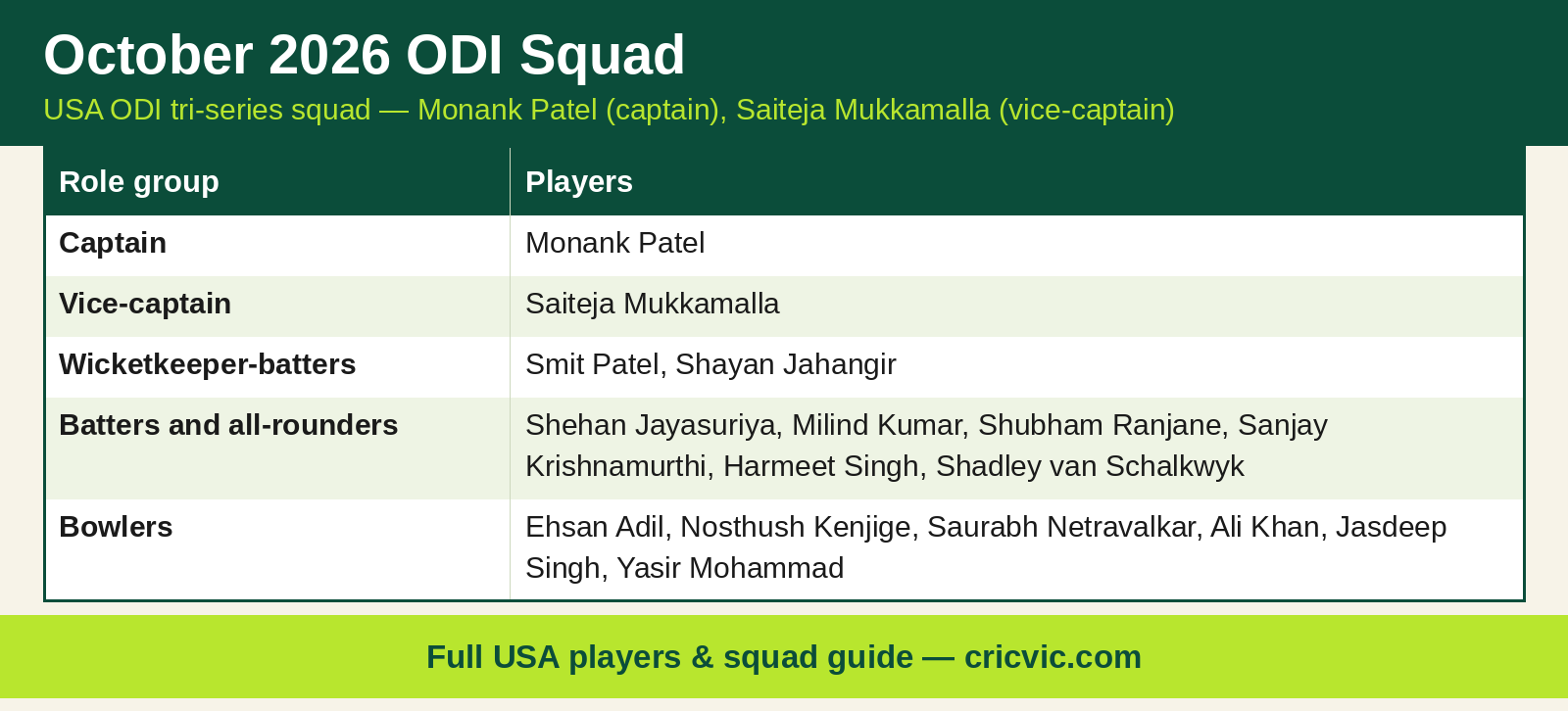
The lesson for readers is simple: when you search for the "USA cricket team squad", always check which series and which format the list belongs to. A squad from February 2026 will not be identical to a squad from October 2026, and neither should be treated as a permanent team sheet.
Batters
The USA batting line-up is built around players who can anchor an innings and players who can accelerate it. The captain sets the tone at the top, while the middle order provides the power hitting that modern white-ball cricket demands.
Monank Patel is the central figure. As captain and wicketkeeper-batter, he bats in the top order and leads from the front. His most important recent innings came in October 2026, when he scored 108 from 100 balls against Namibia in Dallas, chasing 299 to win the League 2 title. That innings showed both sides of his game: patience to build a chase, and the ability to finish it under pressure.
Saiteja Mukkamalla is one of the most important young batters in the side. Listed as an opening batter in squad guides, he has become a regular at the top of the order and a future leader, as shown by his vice-captaincy in the October 2026 ODI squad. His ODI record underlines his value: by October 2026 he had scored 1,605 ODI runs at an average of 40.12, the third-highest ODI total for the USA.
Milind Kumar brings class to the middle order. His ODI numbers are striking: 1,380 runs at an average of 62.72 by October 2026. That average is helped by not-out innings, but it still reflects how often he has finished games or held an innings together. In the League 2 run, he also scored an unbeaten 116 from 84 balls against the UAE, a reminder that he can change tempo when a chase demands it.
Andries Gous is the most aggressive of the top-order options. In the 2024 T20 World Cup he was the USA's top run-scorer, with 219 runs in six innings at an average of 43.80 and a strike rate above 151, including two fifties. That tournament established him as a player who does not wait for the bowlers to make a mistake. He has also been a prolific Major League Cricket batter for Washington Freedom, including a breakthrough 2026 season in which he scored 547 runs in 13 matches at a strike rate of 165.25.
Shayan Jahangir is a wicketkeeper-batter who adds depth to the batting order. He was part of both the 2026 T20 World Cup squad and the October 2026 ODI squad, and in the League 2 title match he contributed 74 runs from 75 balls alongside the captain's century, as well as taking three wickets for 30 runs. That kind of two-way contribution is why he is valued beyond his batting alone.
Shehan Jayasuriya is another batter who can contribute with the ball. His 74 in the League 2 final, combined with his bowling return in the same match, shows why selectors keep him in both formats. He was seeking his first international cap at the time of the 2026 T20 World Cup announcement, which makes his rise to a title-winning performance later that year a useful story for readers who follow the team's development.
Wicketkeepers
The USA has unusual depth behind the stumps, because its captain is a wicketkeeper, and at least two other squad members can also keep wicket.
Monank Patel is the first-choice wicketkeeper-batter and captain. Keeping wicket while captaining and batting in the top order is a heavy workload, and it is one reason his leadership is so central to the team. When he is in the side, the balance of the team changes, because the wicketkeeper's place does not have to be filled by a specialist who bats lower down.
Andries Gous is the second main wicketkeeping option. He kept wicket in the 2024 T20 World Cup and was the team's top scorer in that tournament, which shows that he is not a reserve keeper in the old sense. He is a frontline batter who can also take the gloves.
Shayan Jahangir is the third wicketkeeper-batter in recent squads. Having three players who can keep wicket gives the selectors flexibility. They can pick an extra batter or bowler without worrying about who will stand behind the stumps if the captain needs a break, or if conditions demand a different combination.
Smit Patel also appears as a wicketkeeper-batter in the October 2026 ODI squad. In the League 2 title match against Namibia, he scored 50 runs and helped steady the chase after early wickets. His presence in the ODI squad, rather than the T20 World Cup squad, again shows how format-specific selection can be.
All-Rounders
All-rounders are the glue of the USA team. They allow the captain to play an extra batter or an extra bowler without losing balance, and several of them have changed matches with both bat and ball.
Harmeet Singh is a left-arm spin all-rounder. He played age-group and state cricket in India before moving to the United States, and that experience shows in his control in the middle overs and his useful lower-order batting. By October 2026 he had taken 44 ODI wickets for the USA, and his T20I batting strike rate, above 148 in the career list to 2025, shows that he can score quickly when the team needs it.
Shadley van Schalkwyk is a South African-born all-rounder who moved to the United States in 2020 after more than a decade in South African domestic cricket. He became eligible for the USA in 2024 under ICC residency rules, having not played senior international cricket for South Africa. His all-round value was clear in the 2026 T20 World Cup, where he was among the USA's leading wicket-takers in the tournament phase covered by ICC records, and he remains a regular in both white-ball squads.
Sanjay Krishnamurthi is a younger all-rounder who has grown into a regular place. In the 2026 T20 World Cup he scored 106 runs in four matches at a strike rate of 155.88, including a 68 not out from 33 balls against Namibia. That innings, in a winning cause, is the kind of performance that turns a squad player into a first-choice player.
Shubham Ranjane is another emerging all-rounder. He was seeking his T20I debut at the 2026 T20 World Cup, having already played ODIs for the USA, and he finished that tournament as the USA's top scorer with 141 runs in four matches at a strike rate of 180.77. For a player making his T20I debut at a World Cup, that is a remarkable return, and it puts him firmly in the conversation for future squads.
Milind Kumar and Shehan Jayasuriya are also used as batting all-rounders in different combinations, depending on conditions. The point is not to label every player rigidly, but to understand that the USA's strength is its flexibility: several players can do two jobs, which matters greatly in tournaments where injuries and form can change a team overnight.
Fast Bowlers
The USA pace attack is led by two very different fast bowlers, supported by a group of seamers who offer control and variety.
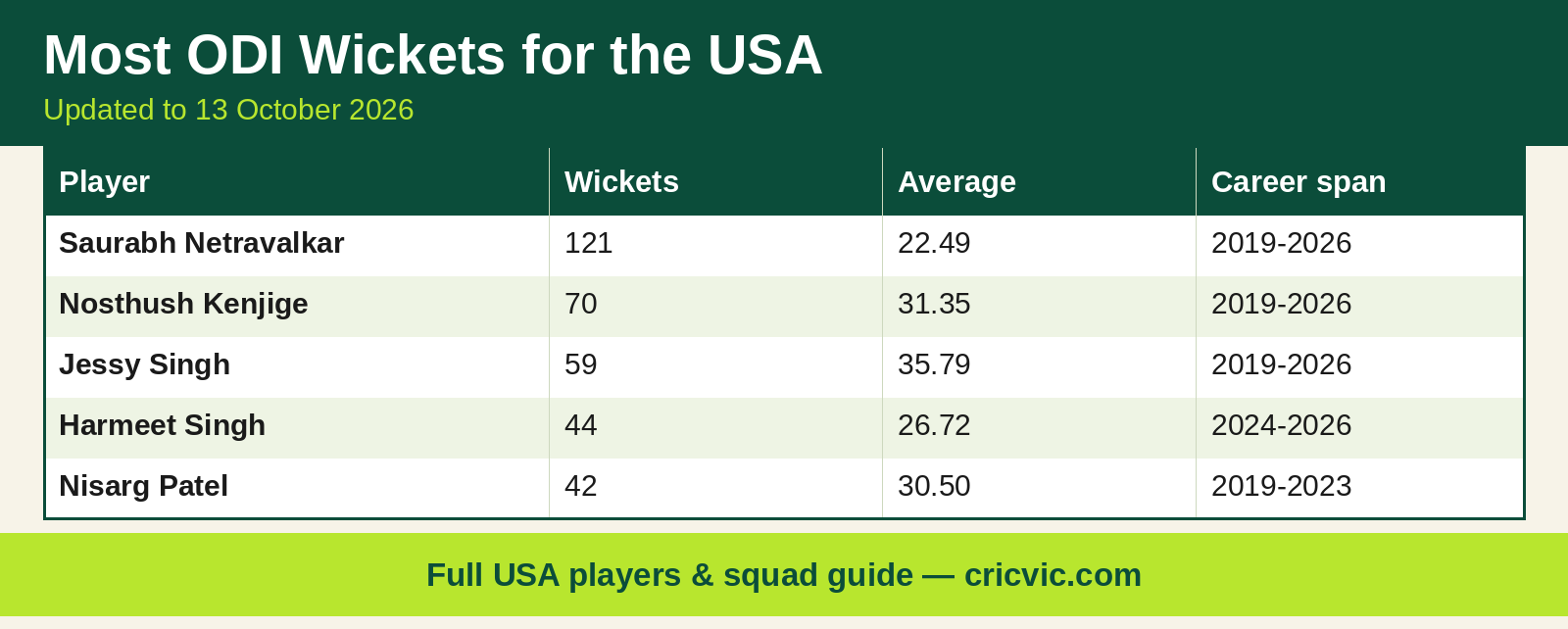
Saurabh Netravalkar is the leader of the attack and the USA's most successful ODI bowler. By October 2026 he had taken 121 ODI wickets at an average of 22.49, far ahead of any other USA bowler. His story is well known in associate cricket: a former India Under-19 and Mumbai domestic cricketer who moved to America for a software engineering career and then became the USA's premier left-arm seamer. His new-ball spells in the 2024 World Cup were widely praised, and he remains the bowler the captain turns to for early wickets and for control at the death.
Ali Khan is the other senior fast bowler. A fiery right-arm quick, he brings genuine pace and aggression, and his ODI best of 7 for 32 against Jersey in April 2023 remains the best ODI bowling performance by a USA player. He returned to the ODI setup in October 2026 after three years away from that format, having last played an ODI in July 2023 against Zimbabwe. His experience in franchise leagues around the world, including Major League Cricket, makes him a valuable tournament bowler.
Jessy Singh is the vice-captain from the 2026 T20 World Cup squad and a pace bowler who has been part of the USA setup for several years. By October 2026 he had taken 59 ODI wickets, the third-highest total for the USA. His leadership role, combined with his bowling, makes him one of the senior voices in the dressing room.
Jasdeep Singh offers control with the new ball and was part of the October 2026 ODI squad. He is the kind of bowler who does not always take headlines, but who allows the captain to build pressure from one end while strike bowlers attack from the other.
Ehsan Adil is a fast bowler whose importance was underlined in the League 2 title match, where he took four wickets for 41 runs from eight overs against Namibia. That performance, in a final that decided a title, is the best evidence of his value in big matches.
Spin Bowlers
Spin is not an afterthought for the USA. In subcontinental conditions, and in the middle overs of both ODI and T20I cricket, the spinners often decide whether the opposition can accelerate or is held back.
Nosthush Kenjige is the leading specialist spinner. A left-arm spinner, he had taken 70 ODI wickets by October 2026, the second-highest total for the USA. His most famous recent performance came in September 2025, when he took five wickets for 11 runs as the USA defended just 122 against Oman at Al Amerat, winning by 57 runs. Oman were bowled out for 65, and that remains the lowest total ever successfully defended in a completed men's ODI. Kenjige's role in that match is a reminder that a spinner can win a low-scoring game outright.
Harmeet Singh, already discussed as an all-rounder, is also a key spinner. His left-arm spin gives the captain a second spin option who can also bat, which is particularly useful in T20 cricket where team balance is tight.
Yasir Mohammad was part of the October 2026 ODI squad as a bowling option, and Mohammad Mohsin was part of the 2026 T20 World Cup squad. Both add depth to the spin and bowling group, and both were seeking to establish themselves as regulars at the time of their selection. Their inclusion shows that the selectors are willing to back younger bowlers in major tournaments, rather than always returning to the same names.
Key Players in Detail
Some players deserve a closer look, because they define how the USA plays.
Monank Patel, captain. Monank is the team's most prolific ODI batter, with 2,570 ODI runs at an average of 34.72 by October 2026, and its captain in both formats. His League 2 century against Namibia in Dallas was not just a personal milestone; it won a title and secured a place in the 2027 World Cup Qualifier. Captains are often judged by how they perform when a tournament is on the line, and that innings is the strongest recent evidence for his leadership.
Saurabh Netravalkar, pace leader. Netravalkar's ODI record, 121 wickets at 22.49, is the foundation of the USA bowling attack. He is also a symbol of the team's pathway: a player who built a professional life in the United States and then built an international career from domestic cricket. For young American players, his career is proof that the pathway works.
Andries Gous, attacking batter. Gous changed how the USA bats at the top of the order. His 2024 World Cup runs came at a strike rate above 151, and his Major League Cricket form in 2026, including 132 from 51 balls for Washington Freedom against MI New York in an eliminator, showed that he can dominate franchise attacks as well as international ones. That 132 was the highest score by an American player in Major League Cricket at the time.
Milind Kumar, middle-order anchor. Milind's ODI average of 62.72 is the highest among USA batters with a substantial number of runs, and his unbeaten 116 against the UAE in the League 2 run showed that he can finish a chase as well as build one. He is the player the team looks to when wickets have fallen and an innings needs rebuilding.
Saiteja Mukkamalla, future leader. Mukkamalla's rise from opening batter to ODI vice-captain in October 2026 is one of the clearest signs of a changing of the guard. With 1,605 ODI runs at 40.12, he is already third on the USA's all-time ODI run list, and he is still early in his career. If the USA is to build a team for the 2027 World Cup and beyond, he will be at its centre.
Emerging Players to Watch
The most exciting part of USA cricket in 2026 is not the established core, but the players pushing from below. Major League Cricket has created a professional pathway, and Minor League Cricket feeds it. The result is a pipeline that did not exist a decade ago.
Sanjay Krishnamurthi and Shubham Ranjane have already made the step up, as shown by their performances at the 2026 T20 World Cup. Mohammad Mohsin and Shehan Jayasuriya were also new international names in that squad, and Jayasuriya's later League 2 final performance shows how quickly a new player can become important.
Beyond the current squad, uncapped players in Minor League Cricket are now being watched specifically because of the Los Angeles 2028 Olympics, where eligibility rules differ from regular ICC selection. One example reported by Cricbuzz is Kunwarjeet Singh, a California-born right-hander who scored more than 500 runs in 19 Minor League Cricket innings across two seasons. He has not yet become a regular international, but his domestic record makes him a name to follow.
The key point for readers is that the USA squad will keep changing. New players will come through Minor League Cricket, perform in Major League Cricket, and then earn national selection. That is the intended pathway, and it is working.
ODI vs T20I Squad
It is tempting to talk about "the USA squad" as if it were one team, but the ODI and T20I squads serve different purposes.
The ODI squad is built for 50 overs. It needs batters who can build long innings, bowlers who can bowl ten overs, and a balance that can survive a bad first ten overs. That is why players like Smit Patel, Ehsan Adil and Jasdeep Singh appear in ODI squads, and why Milind Kumar's ability to anchor an innings is so valuable.
The T20I squad is built for 20 overs. It needs power hitters, bowlers who can bowl at the death, and fielders who can save runs in the outfield. That is why players like Andries Gous, Shubham Ranjane and Sanjay Krishnamurthi, with their high strike rates, are so important in T20I cricket, and why a player can be a T20I regular without being an ODI regular, or vice versa.
The captain, the pace leaders and the main spinners appear in both formats, because they are the core of the team. Around them, the selectors rotate players based on form, conditions and the specific demands of the tournament. Readers should therefore always check the format when they see a squad list.
Player Records
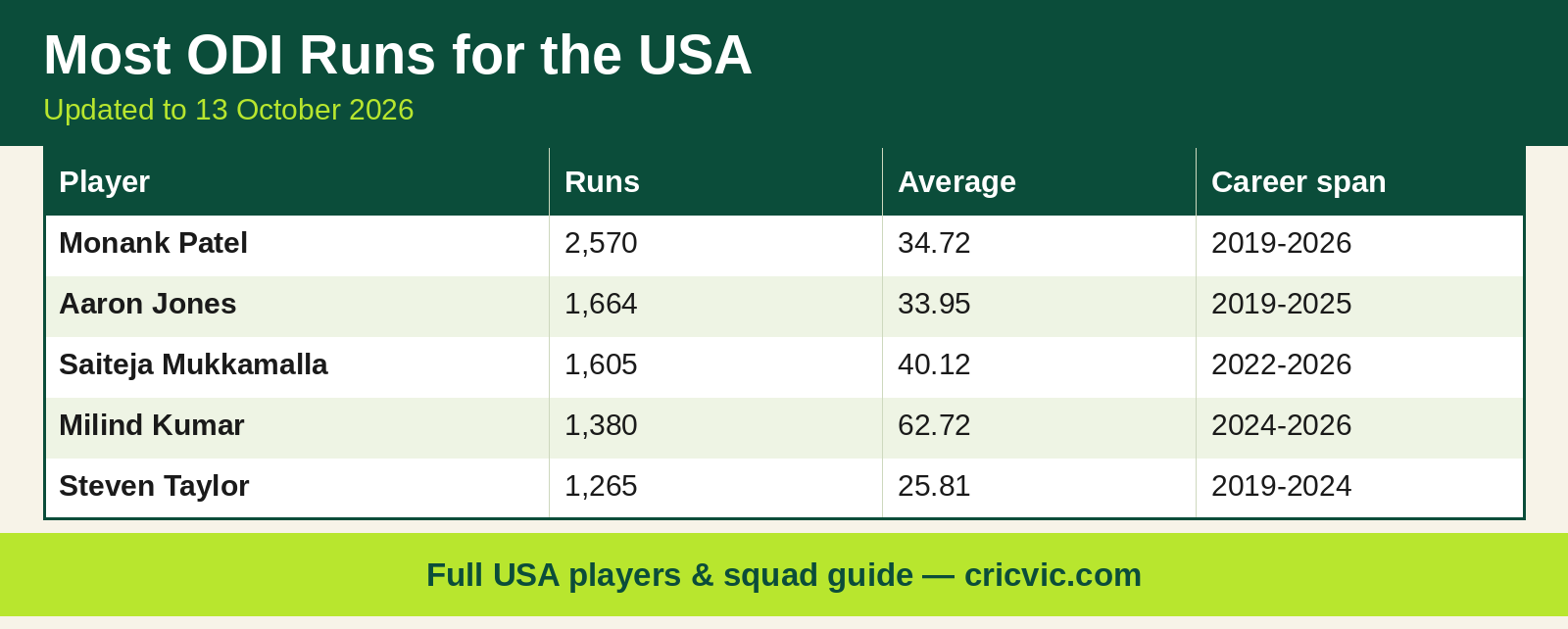
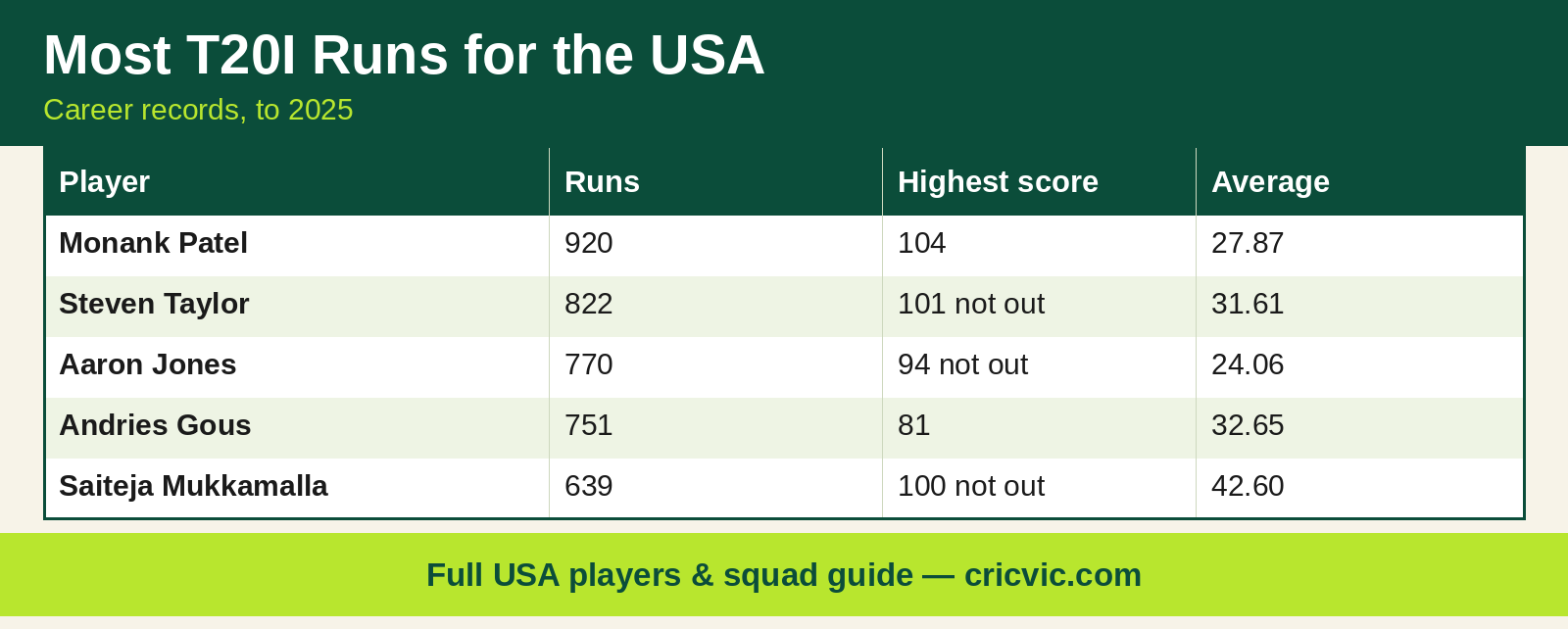
Records help put individual players in context. The tables below use ODI records updated to 13 October 2026, and T20I career records to 2025, because those were the latest complete lists available at the time of writing. Later matches will change these numbers, and they should be read as a snapshot, not as a final total.
Most ODI Runs for the USA
Most ODI Wickets for the USA
Most T20I Runs for the USA (career, to 2025)
Two individual records stand out beyond these lists. The highest ODI score by a USA player is 173 not out by Jaskaran Malhotra against Papua New Guinea at Al Amerat in September 2021. The best ODI bowling figures are 7 for 32 by Ali Khan against Jersey at Windhoek in April 2023. The highest ODI team total is 361 for 3 against Canada at Windhoek in September 2024.
How Players Qualify and Get Selected
Many readers ask how a player who was born outside the United States can play for the USA. The answer has two parts: residency and pathway.
Under ICC eligibility rules for associate nations, a player who has not represented another country at senior international level can become eligible after a continuous residency period, generally three years, in the associate nation. Shadley van Schalkwyk is a clear example: he moved to the United States in 2020, had not played senior international cricket for South Africa, and became eligible in 2024 after fulfilling the residency requirement and performing in domestic American cricket.
The pathway itself is designed to be clear, even if it is still being unified. A player starts in a local league or academy, performs well enough to be selected for Minor League Cricket, and from there can be drafted into Major League Cricket. Strong performances in Major League Cricket then bring a player into national selection conversations. That is the route described by Major League Cricket leadership: local league to Minor League Cricket, to Major League Cricket, and then hopefully to Team USA colours.
There is one important nuance for the future. Olympic eligibility is different from ICC eligibility. For the Los Angeles 2028 Olympics, where cricket returns after 128 years, a player generally needs to be a citizen of the country they represent, which is a stricter test than ICC residency. That means the Olympic player pool could look different from the regular ICC squad. This guide notes that difference, but does not claim a final Olympic squad, because that selection has not yet happened.
For the 2026 T20 World Cup, selection was carried out under a special process, because USA Cricket was under ICC suspension at the time. The ICC worked with the United States Olympic and Paralympic Committee to establish a new selection process, with selection panel members submitting conflict-of-interest forms and a compliance officer observing the meeting. That process, rather than a normal board selection, produced the 2026 World Cup squad.
FAQs
Who is the captain of the USA cricket team?
Monank Patel is the captain in both ODI and T20I cricket. Jessy Singh was vice-captain for the 2026 T20 World Cup, while Saiteja Mukkamalla was vice-captain for the October 2026 ODI tri-series.
Who is the best batter for the USA?
By ODI runs, Monank Patel leads with 2,570 runs, followed by Aaron Jones and Saiteja Mukkamalla. By ODI average among the leading run-scorers, Milind Kumar leads with 62.72. In T20I cricket, Monank Patel also leads the career run list to 2025, while Andries Gous was the top scorer at the 2024 T20 World Cup.
Who is the best bowler for the USA?
Saurabh Netravalkar is the leading ODI wicket-taker with 121 wickets, followed by Nosthush Kenjige with 70. Ali Khan holds the best single ODI bowling performance, 7 for 32 against Jersey.
Why is Aaron Jones not in the 2026 T20 World Cup squad?
Aaron Jones was a key player in the 2024 T20 World Cup, including a famous 94 not out against Canada, and he remains second on the USA's ODI run list. He was not, however, named in the 15-player squad for the 2026 T20 World Cup. Squad selection changes by tournament, and this guide lists him as a former core player rather than claiming he was in a squad where he was not.
Do all USA players need to be American citizens?
No, not for regular ICC cricket. ICC residency rules allow a player to become eligible after a continuous residency period, provided they have not played senior international cricket for another country. Olympic eligibility is stricter and generally requires citizenship, which is why the LA28 squad could differ from the regular ICC squad.
How does a young player get into the USA team?
Through the domestic pathway: local leagues and academies, then Minor League Cricket, then Major League Cricket, and then national selection based on performance. There is no shortcut, and domestic form is the main route into the national conversation.
Conclusion
The USA cricket team players and squad tell a story of growth. A decade ago, the team was searching for an identity. Today, it has a captain in Monank Patel who has won a League 2 title with a century in the final, a pace leader in Saurabh Netravalkar who has taken more than 120 ODI wickets, an attacking batter in Andries Gous who can dominate franchise cricket, and a new generation in Mukkamalla, Krishnamurthi and Ranjane who are already winning World Cup matches.
The squad will keep changing, and that is a good thing. It means the pathway is working, and new players are pushing the established names. For readers, the best way to follow the team is to check the squad for each specific series, rather than assuming one list lasts forever.
For the full story of the team, read the main USA cricket team guide, and for the domestic league that feeds this squad, read the Major League Cricket guide. The next articles in this series will cover the USA women's team and the USA Under-19 team, which are the other two pillars of American cricket's future.
Meta title: USA Cricket Team Players and Squad: Full Guide 2026
Meta description: Meet the USA cricket team players and squad: captain Monank Patel, key batters, bowlers, all-rounders, records, and how players qualify for Team USA.
Focus keyword: usa cricket team players