Key Takeaways
· These seven records have stood a combined nearly 70 years of challenges across the world's T20 leagues — and none looks remotely threatened today.
· Chris Gayle's 175* is no longer the highest T20 score (Lhuan-dre Pretorius broke it with 188* in October 2026) — but the 30-ball hundred from that same innings still stands untouched in league cricket.
· Virat Kohli's 2016 season — 973 runs, four hundreds — remains the greatest single season any league has ever seen, ten years on.
· What protects league records is the structure of franchise cricket itself: the auction churn, the four-over bowling cap, and squads that rebuild every year.
· Amit Mishra's record is frozen in time — three hat-tricks for three different teams, and he retired in 2025.
In This Article
· The 7 Records at a Glance
· 1. Chris Gayle — 30 Balls: The Fastest Hundred League Cricket Has Ever Seen
· 2. Kohli & de Villiers — 229: The Partnership That Broke the Format
· 3. Virat Kohli — 973: The Season Nobody Has Touched in 10 Years
· 4. Amit Mishra — Three Hat-Tricks, Three Teams: The Hat-Trick King
· 5. Alzarri Joseph — 6/12 on Debut: The Perfect First Day
· 6. Kolkata Knight Riders — 10 Straight Wins: The Streak That Spanned a Title
· 7. Glenn Maxwell — 154*: The BBL's Lone 150
· What Makes a League Record Truly Unbreakable?
· FAQs
· The Bottom Line
The 7 Records at a Glance
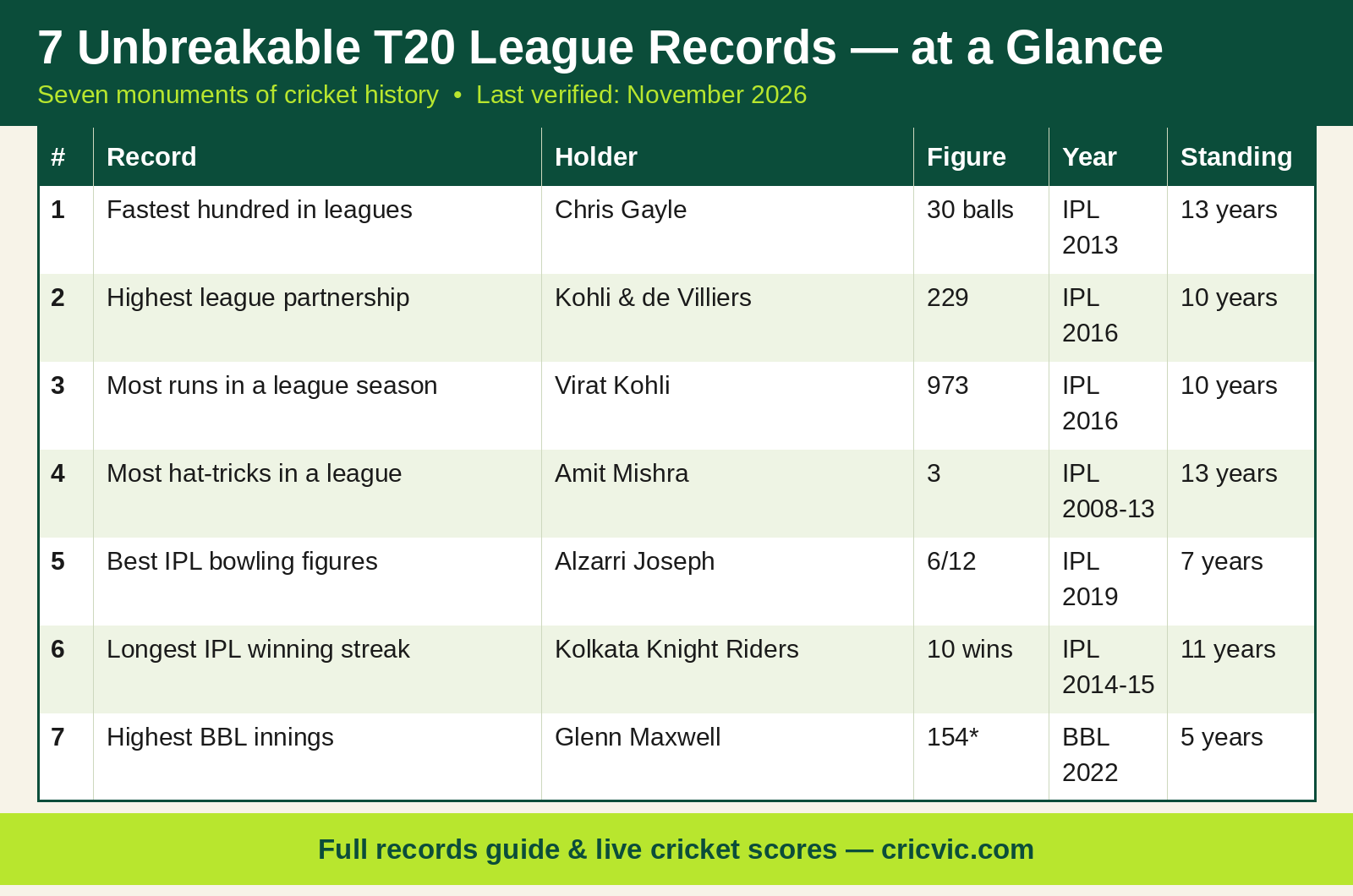
T20 leagues were supposed to make records disposable. New season, new auction, new stars, new numbers — the format moves too fast for anything to last. And yet, buried in the scorecards of the IPL, the BBL, and the leagues that followed, there are monuments. Records set in an afternoon or across a season that have survived every power-hitter, every mystery spinner, and every tactical revolution since.
These seven are different from the usual leaderboard entries. They are not waiting to be broken; they are protected by the very structure of franchise cricket — the auction churn that breaks up great teams, the four-over cap that limits great bowlers, and the knockout pressure that ends great runs. Each one tells a story worth retelling.
Last verified: 4 November 2026.
Chris Gayle — 30 Balls: The Fastest Hundred League Cricket Has Ever Seen
A word of honesty first, because the game has moved on: Chris Gayle's 175 not out is no longer the highest score in T20 cricket. On 2 October 2026, South Africa's Lhuan-dre Pretorius smashed 188 not out off 79 balls for the Titans against the Knights in the CSA T20 Challenge, and the most famous innings in league history slipped to number two. Records fall. That is the sport.
But here is what did not fall — what came from the very same innings, on 23 April 2013, at the M. Chinnaswamy Stadium in Bengaluru, when Gayle walked out for Royal Challengers Bengaluru against the Pune Warriors and produced the most violent batting the league game has ever seen.
The sequence still reads like a misprint: fifty off 17 balls, a hundred off 30 balls, 150 off 53. He finished 175 not out off 66 balls — 13 fours, 17 sixes, a strike rate of 265.15. RCB made 263 for 5 and won by 130 runs. And the hundred, brought up in 30 balls, remains the fastest hundred in T20 league cricket, thirteen years later.
The chasing pack tells the story of its safety. In all the IPL seasons since, the nearest anyone has come is 35 balls — Vaibhav Suryavanshi in 2025. The 30-ball mark has been equalled only in internationals, by Abhishek Sharma in a T20I in 2026. In the leagues, where the world's best hitters face the world's best bowling attacks every single season, nobody has got within five balls of it.
Why it will stand: A 30-ball hundred demands roughly 16.7 runs per over of uninterrupted boundary hitting across five overs — no dot balls, no quiet overs, no mis-hits finding fielders. Thirteen seasons of the most destructive batters ever assembled have tried, on the flattest pitches, with the best bats, and the gap has not closed. The number is not just fast; it is a different sport from everyone else's fast.
Kohli & de Villiers — 229: The Partnership That Broke the Format
Some partnerships build innings. On 14 May 2016, at the Chinnaswamy in Bengaluru, Virat Kohli and AB de Villiers built something that broke the format's sense of what was possible. Royal Challengers Bengaluru were playing the Gujarat Lions. What followed, in under a hundred balls, was 229 runs for the second wicket — the highest partnership in T20 franchise-league history.
The details are worth savouring. De Villiers made 129 not out off 52 balls; Kohli made 109 off 55. It was only the second instance ever of two hundreds in a single T20 innings. RCB finished 248 for 3 and won by 144 runs. And the same pair own the second-best league stand as well — 215 not out against Mumbai Indians at Wankhede in 2015. They are the only pair with two 200-plus stands in T20 cricket.
An honest caveat, because the record books are precise: higher partnerships exist in internationals — 258 by Japan against China in 2024, 236 by Afghanistan against Ireland in 2019. But in franchise leagues, where bowling attacks are deeper and more varied than anything international minnows face, 229 has stood for ten years. The BBL's best is 211 (December 2025); the PSL's best is 191 (2026). Both still well short.
Why it will stand: A 229-run stand needs two of the greatest T20 batters ever peaking on the same evening, against an attack that cannot buy a breakthrough, for the better part of two hours. The modern league game — with its match-ups, its bowling changes, its data-driven plans for every batter — is specifically designed to prevent exactly this. Ten years of trying, across every major league, and nobody has got within 18 runs of it.
Virat Kohli — 973: The Season Nobody Has Touched in 10 Years
If Gayle's hundred was an afternoon of violence, Kohli's 2016 was two months of sustained perfection. In IPL 2016, playing for Royal Challengers Bengaluru, Virat Kohli scored 973 runs in 16 innings — four hundreds, seven fifties, an average of 81.08, a strike rate of 152.03. He won the Orange Cap by a distance. RCB reached the final, where they lost to Sunrisers Hyderabad by 8 runs — the only blemish on a season that remains the greatest any league has ever seen.
The numbers around it show how far ahead it was. The next-best season ever is Shubman Gill's 890 in 2023 — still 83 runs short. Jos Buttler made 863 in 2022. Nobody has crossed 900 in a season since. There is a record inside the record, too: four hundreds in a single IPL season, a mark nobody has matched. And for league-wide context, the best season outside the IPL is Marcus Stoinis's 705 in BBL 2019–20 — nearly 270 runs behind.
Why it will stand: Nine hundred and seventy-three runs means averaging around 61 per innings across a full season with no lean patch, no rest, no bad week. The modern game works against it: squad rotation, format-hopping between leagues, managed workloads. Kohli played every game of a long season in the form of his life. Ten years of challengers — including the two greatest white-ball batters of the next generation — have not got within 80 runs.
Amit Mishra — Three Hat-Tricks, Three Teams: The Hat-Trick King
A hat-trick in T20 cricket is lightning in a bottle: three perfect balls, three compliant batters, one over. Amit Mishra caught lightning three times — for three different franchises, across six seasons. Nobody else in league cricket has done it twice for more than one team, and nobody has done it three times at all.
The three, in order: 2008, for Delhi Daredevils against Deccan Chargers — 5 for 17, the victims Ravi Teja, Pragyan Ojha, and RP Singh. 2011, for Deccan Chargers against Kings XI Punjab at Dharamsala. 2013, for Sunrisers Hyderabad against Pune Warriors at Pune — 4 for 19. Three teams, three seasons, three hat-tricks. Yuvraj Singh and Yuzvendra Chahal have two each; through IPL 2026, there have been 22 hat-tricks by 18 bowlers in total, and Mishra owns three of them alone.
And now the record is frozen. Mishra retired in September 2025 after 162 IPL matches and 174 wickets, taking his hat-tricks with him into history. No active bowler is within one of the mark, let alone two.
Why it will stand: A single hat-trick is a statistical miracle; three is a career of them. It requires longevity (18 seasons of IPL cricket and counting, and only one man has three), adaptability (three different teams, three different attacks around him), and the leg-spinner's eternal gift for deceiving batters who have seen everything. With its holder retired, the record now waits for someone to start from zero — in a format where even one hat-trick is a career highlight.
Alzarri Joseph — 6/12 on Debut: The Perfect First Day
On 6 April 2019, at the Rajiv Gandhi International Stadium in Hyderabad, a 22-year-old from Antigua walked out for his IPL debut. Alzarri Joseph had been signed by Mumbai Indians as an injury replacement for Lasith Malinga — the greatest T20 bowler of them all. Nobody expected what came next.
Joseph took a wicket with his first ball in the IPL — David Warner, no less. He kept going: Vijay Shankar, Deepak Hooda, Rashid Khan, Bhuvneshwar Kumar, Siddarth Kaul. When he finished, his figures read 6 for 12 in 3.4 overs. Sunrisers Hyderabad were bowled out for 96 chasing 137; Mumbai won by 40 runs. The spell broke Sohail Tanvir's 6 for 14 from 2008, which had stood for eleven years.
Seven years on, it remains the best bowling figures in IPL history. Only three six-wicket hauls exist in the league's history — Joseph, Tanvir, and Adam Zampa's 6 for 19. And here is the line that protects it: through the end of the 2026 season, no bowler has ever taken seven wickets in an IPL innings.
Why it will stand: Six wickets in a T20 innings means dismissing sixty percent of the opposition almost single-handedly, in a maximum of four overs — and Joseph did it on debut, with his first ball. The four-over cap is the record's bodyguard: even a bowler having the day of his life gets only 24 balls. To take seven, everything would have to go perfectly, and in eighteen IPL seasons, it never has.
Kolkata Knight Riders — 10 Straight Wins: The Streak That Spanned a Title
The 2014 Kolkata Knight Riders were nearly dead. Five defeats in their first seven games, the season slipping away, Gautam Gambhir's side staring at elimination. Then they simply stopped losing — and did not lose again for eleven months.
Nine straight wins closed the 2014 season, including Qualifier 1 and the final against Kings XI Punjab, where Manish Pandey's 94 off 50 sealed the title. Then, in the 2015 opener, they beat Mumbai Indians by seven wickets to make it ten. Royal Challengers Bengaluru finally ended the run. Ten consecutive IPL victories — the only double-digit winning streak in the league's history, eleven years and counting.
Why it will stand: Ten straight wins in the IPL means surviving everything the format throws at a team: injuries, away games, knockout pressure, and — uniquely — the auction reset between seasons, which is specifically designed to break up great sides. The salary cap exists to prevent dynasties. KKR's streak spanned that reset, winning a title along the way. In a league engineered for parity, ten in a row is the system failing beautifully — and the system has been fixed since.
Glenn Maxwell — 154*: The BBL's Lone 150
Not every monument is Indian. On 19 January 2022, at the Melbourne Cricket Ground, Glenn Maxwell produced the most destructive innings in Big Bash history: 154 not out off 64 balls for the Melbourne Stars against the Hobart Hurricanes — 22 fours, 4 sixes, a strike rate of 240.62, the hundred coming off 41 balls. The Stars finished 273 for 2, still the highest team total in BBL history, and won comfortably.
Five years on, Maxwell remains the only batter to pass 150 in fifteen BBL seasons. The chasing pack keeps falling short: Marcus Stoinis's 147 not out in 2020, Josh Brown's 140 in 2024 — both magnificent, both still short of the only 150 the league has ever seen.
Why it will stand: The BBL has played fifteen seasons with the best Australian talent and a rotating cast of overseas stars, on good batting pitches, and exactly one man has reached 150. The 150 club has a single member because the BBL's pitches, its longer boundaries, and its bowling depth conspire against the very biggest scores. Every season, someone gets close. Every season, the record survives.
What Makes a League Record Truly Unbreakable?
League cricket was designed to make records disposable — and that design is exactly what protects the records above. Four structural features of franchise cricket guard them, and every record on this list leans on at least three.
First, the auction churn. Franchise squads rebuild every year. Great teams are broken up by design; great combinations — like Kohli and de Villiers — are temporary by contract. A record that required a specific group of players at their peak together is protected by the fact that the group cannot stay together.
Second, the four-over cap. No bowler, however hot, gets more than 24 balls. Joseph's 6 for 12 and Mishra's hat-tricks were achieved inside a hard ceiling that makes the truly freakish bowling figures — the seven-fers, the repeated hauls — structurally near-impossible. The cap is the same for everyone, every game, forever.
Third, the format-hopping calendar. Modern players move between leagues and formats constantly. The uninterrupted run of form that Kohli's 973 required — sixteen innings, no rest, no lean patch — is harder to assemble now than it was in 2016, not easier. Rotation and rest are the enemies of accumulation records.
Fourth, the decade test. This is the simplest and the most ruthless. Gayle's hundred has survived thirteen IPL seasons of the most destructive hitters ever assembled. KKR's streak has survived eleven. An unbreakable league record needs a decade of failed challenges behind it — which is why the newest leagues, for all their excitement, have no entries on this list yet. Check back in the 2030s.
Frequently Asked Questions
Is Gayle's 175* still the highest T20 score?
No — and this article says so plainly. Lhuan-dre Pretorius scored 188 not out off 79 balls for the Titans against the Knights in October 2026, and Gayle's 175* is now number two. What survives from that 2013 innings is the 30-ball hundred — still the fastest in league cricket, thirteen years on.
Has anyone come close to Kohli's 973?
The nearest is Shubman Gill's 890 in 2023 — 83 runs short, which across a season is a canyon. Jos Buttler's 863 in 2022 is the only other season above 850. Nobody has crossed 900 since Kohli, and the four-hundreds-in-a-season mark inside the record still stands alone too.
Why don't modern power-hitters break the 30-ball hundred?
Because the gap is not closing. Thirteen IPL seasons of the most destructive batters ever — the power-hitting era at its peak — and the nearest anyone has come is 35 balls. A 30-ball hundred allows essentially no downtime across five overs; one dot ball, one good over, and it is gone. The modern game has made batting faster in general, but this specific number sits in a different universe.
Could a bowler take 7 wickets in an IPL innings?
Never happened through the 2026 season — eighteen seasons, thousands of innings, zero seven-fers. Only three bowlers have even taken six. The four-over cap means a bowler gets 24 balls maximum; to take seven, nearly every ball would have to be a wicket ball. Joseph's 6 for 12 came on debut, first ball — and even that day of days stopped at six.
Which record is most likely to fall first, if any?
Honestly? None of them soon. But if one cracks, the 229 partnership faces the deepest pool of batting talent — every season brings new destructive pairs. Even so, the BBL and PSL bests (211 and 191) are still well short after a decade. "Most likely" here means "least impossible," not "probable."
Are there unbreakable records in newer leagues like the SA20, ILT20, or MLC?
Not yet — and that is by definition. An unbreakable record needs a decade of failed challenges behind it. The SA20, ILT20, and MLC are still young, their record books still being written. The most famous MLC innings so far, Finn Allen's 19 sixes in June 2025, is a candidate for the 2030s list. Check back then.
The Bottom Line
T20 leagues will keep producing records. Every season, someone will score faster, hit further, or take more wickets in a season than anyone before — and you can follow the next would-be record-breakers ball by ball in live cricket matches, or see where the leagues stand in our BBL|16 complete guide and WBBL|12 complete guide.
But these seven are different. They are not waiting to be broken; they are waiting to be appreciated. Each one marks a moment when a player or a team touched something close to perfection — in a format designed to make perfection impossible to repeat — and the years since have only confirmed how far perfection sits from the rest of us.
Records are the game's memory. And some memories, it turns out, are permanent.
Want more? Read the companion pieces, 7 Unbreakable Cricket Records, or check which clashes are coming up next in upcoming cricket matches — because the next monument might be built this week.