Key Takeaways
· These seven records have stood a combined nearly 190 years of challenges — and none looks remotely threatened today.
· Betty Wilson remains the only cricketer EVER, man or woman, to score a century and take 10 wickets in the same Test — Ian Botham needed 22 years to match her.
· Belinda Clark's 229* was the first ODI double hundred in cricket history, by anyone — thirteen years before a man managed one.
· What protects these records is not just the numbers, but the structure of the women's game: vanishing Test cricket, a minimum-age rule, and eras when the fixtures barely existed.
· Sajjida Shah's record is the only one on this list that the ICC has effectively outlawed — no international cricketer under 15 is allowed anymore.
In This Article
· The 7 Records at a Glance
· 1. Betty Wilson — 1958: The Double No One Has Matched in 68 Years
· 2. Belinda Clark — 229*: The First Double Hundred in ODI History (by Anyone)
· 3. Kiran Baloch — 242: The Score the Format Itself May Never Let Anyone Chase
· 4. Sajjida Shah — 12 Years 171 Days: The Record the ICC Had to Outlaw
· 5. Mithali Raj — Seven Straight Fifties: Consistency No One Has Matched
· 6. Australia — 26 Straight ODI Wins: The Streak That Beat the Men's Record
· 7. Annetts & Reeler — 309: The Partnership That Batted for Two Days
· What Makes a Women's Record Truly Unbreakable?
· FAQs
· The Bottom Line
The 7 Records at a Glance
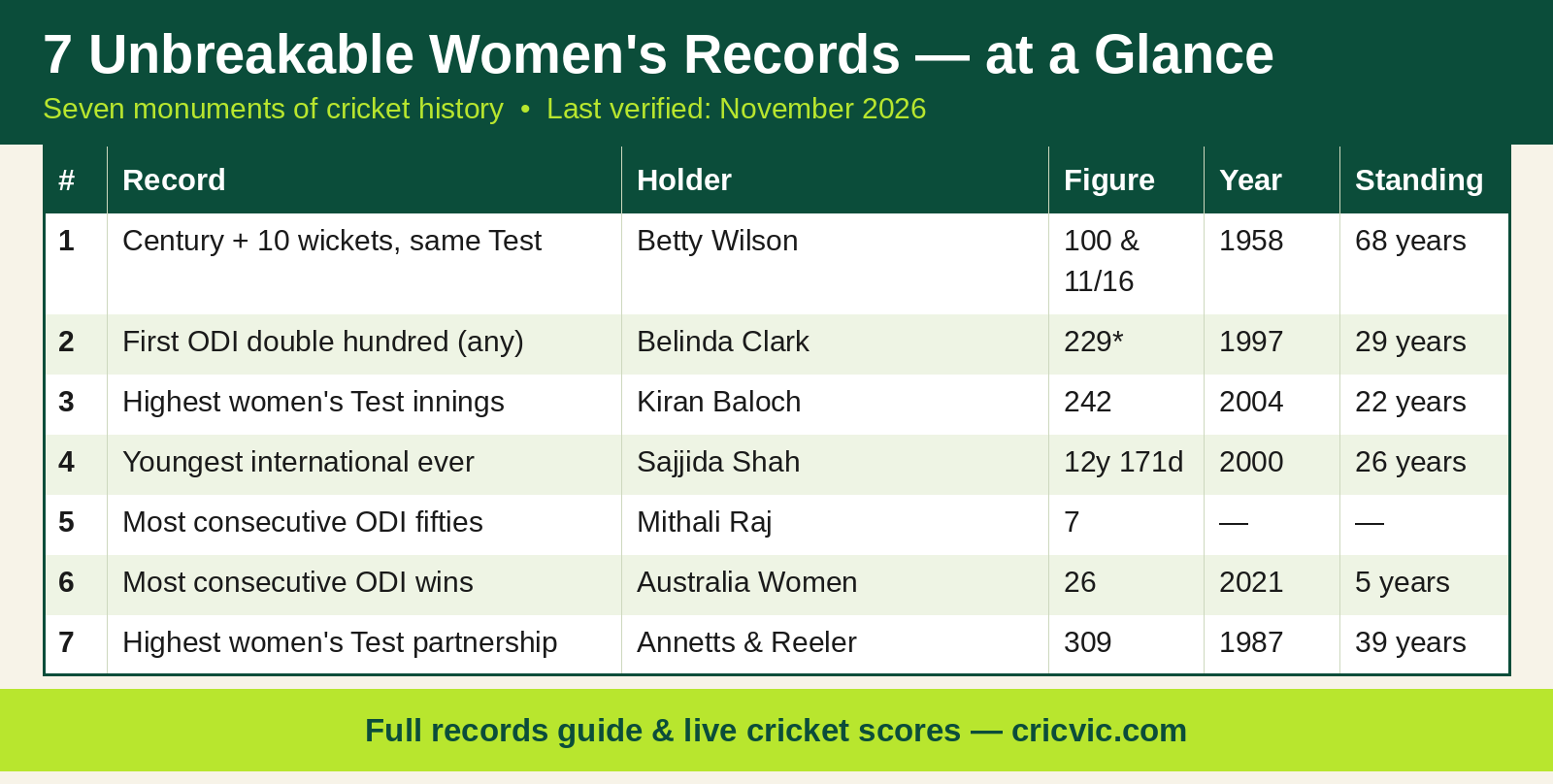
Women's cricket has its own monuments. They were built in quieter eras, in front of smaller crowds, sometimes in matches the history books barely bothered to record — and they have outlasted everything the modern game has thrown at them. Some of these records are protected by numbers so extreme they may never be approached. Others are protected by something stranger: the structure of the sport itself, which has changed in ways that make the attempt nearly impossible.
These seven have survived professionalism, T20 leagues, covered pitches, and generations of athletes better trained than their setters ever were. Each one tells a story worth retelling — and each one has a reason it will almost certainly outlive us all.
Last verified: 2 November 2026.
Betty Wilson — 1958: The Double No One Has Matched in 68 Years
They called her "the female Bradman," and the nickname undersells her. Betty Wilson played 11 Tests for Australia between 1948 and 1958, averaged 57.46 with the bat and 11.80 with the ball — and in one rain-ruined week at St Kilda in February 1958, she did something no cricketer, man or woman, had ever done before or has done since.
Australia were bowled out for 38 in the first innings — Wilson top-scored with 12. Then she took the ball and produced 7 for 7, including the first hat-trick in women's international cricket, as England collapsed for 35. In Australia's second innings she scored a century as they reached 202 for 9 declared. Then she took 4 for 9 in England's second dig. Match figures: 11 for 16. A century and ten wickets in the same Test — the first time it had ever happened in the 81-year history of Test cricket.
Ian Botham was the first man to match it, with 114 and 13 wickets against India at Mumbai in 1980 — twenty-two years later. No woman has ever matched it at all. Pakistan's Shaiza Khan later broke Wilson's 11-wickets-in-a-match mark with 13 against the West Indies in 2004, but the century-plus-ten-wickets double remains Wilson's alone, 68 years on.
Why it will stand: The double demands a once-in-a-generation all-rounder peaking with both disciplines in the same week — and it demands a Test match long and open enough for one player to dominate both innings with bat and ball. Women's Tests are now rare events, a handful a year, which means the opportunities to even attempt the double have nearly vanished. Wilson's record is protected by scarcity as much as by genius.
Belinda Clark — 229*: The First Double Hundred in ODI History (by Anyone)
On 16 December 1997, at the MIG Ground in Bandra, Mumbai, Australia's captain walked out against Denmark in a World Cup group game and rewrote the record books for the entire sport. Belinda Clark batted 155 balls, struck 22 fours, hit zero sixes — and finished 229 not out. Australia made 412 for 3. Denmark were bowled out for 49.
It was the first double century in one-day international cricket. Not the first by a woman — the first by anyone. Sachin Tendulkar's 200 not out against South Africa at Gwalior, the men's first, came thirteen years later in 2010. Clark's innings stood as the highest women's ODI score for 21 years, until 17-year-old Amelia Kerr made 232 not out against Ireland at Dublin in 2018.
The six-less detail is what makes it feel untouchable. Clark's 229 contained no maximums at all — 141 of the runs came in ones, twos, and threes. In an era when power-hitting defines the women's game, a double hundred built almost entirely on running and placement belongs to a style of batting that barely exists anymore. As one tribute put it, it "will surely never be beaten."
Clark wasn't done: she made 970 ODI runs in the 1997 calendar year — still the women's record — and then 52 in the World Cup final against New Zealand at Eden Gardens, in front of some 80,000 people, to lift the trophy.
Why it will stand: The "first double hundred by anyone" can never be taken away — it is history, not a leaderboard. And the innings itself, a six-less 229, belongs to a tactical era that has passed. Modern openers clear the ropes; Clark cleared the fielders. Nobody plays that way anymore, and nobody needs to.
Kiran Baloch — 242: The Score the Format Itself May Never Let Anyone Chase
In March 2004, at the National Stadium in Karachi, Pakistan's Kiran Baloch batted for 9 hours and 44 minutes against the West Indies. She faced 488 balls, struck 38 fours, and finished with 242 — the highest individual innings in women's Test history, a record recognised by Guinness World Records, which also credits her with the most runs by a woman in a single Test match (264, adding her 22 in the second innings).
Pakistan declared at 426 for 7; the match was drawn. Twenty-two years later, the 242 still stands. The nearest challengers — Mithali Raj's 214 in 2002, Ellyse Perry's 213 not out in 2017, Tammy Beaumont's 208 in 2023 — all fell 28 or more runs short.
Here is the stranger part: Pakistan and West Indies both played their last Test match in that very game. The format has been quietly vanishing from the women's calendar for two decades — only a handful of women's Tests are played in any given year, and several major nations have gone years without one. There have been only about eight double hundreds in the entire history of women's Test cricket. Baloch's record is protected not just by the size of the number, but by the shrinking of the stage it was set on.
Why it will stand: To beat 242, a batter needs a Test match, a flat pitch, nearly ten hours of concentration, and an attack that can't dislodge her. Women's Tests are so rare now that most of the world's best batters will retire having played only a few. The record may survive simply because almost nobody gets to attempt it.
Sajjida Shah — 12 Years 171 Days: The Record the ICC Had to Outlaw
On 23 July 2000, in Dublin, a 12-year-old from Lahore walked out to play a one-day international for Pakistan against Ireland. Sajjida Shah was 12 years and 171 days old — the youngest international cricketer ever, man or woman, a record Guinness still holds in her name. A week later she made her Test debut at 12 years 178 days. She went on to play 60 ODIs and take 7 for 4 against Japan in 2003 — at the time the best bowling figures in women's ODI history, and the youngest five-wicket haul.
This is the only record on this list that the authorities have effectively legislated out of existence. In November 2020, the ICC introduced a minimum age of 15 for all international cricket — men, women, and Under-19 — explicitly to improve the safeguarding of players. Boards can apply for special dispensation below 15, but none has been used to field anyone remotely near 12, and the direction of travel in player welfare makes it near-unthinkable.
Why it will stand: It is structurally locked. A record that requires a 12-year-old in international cricket now runs into a global rule designed to prevent exactly that. The ICC didn't just fail to break Sajjida Shah's record — it made the record unbreakable on purpose.
Mithali Raj — Seven Straight Fifties: Consistency No One Has Matched
Some records are about a single day of genius. This one is about refusing to fail, innings after innings. Mithali Raj — 232 one-day internationals, 7,805 runs at 50.68, 64 fifties (the most in women's ODI history), a 23-year career from 1999 to 2022 — once scored fifty or more in seven consecutive ODI innings. She remains the first player, man or woman, to do it.
The streak sits inside one of the great careers in the sport's history: 10,868 international runs, the first Indian captain — man or woman — to lead the country to two ODI World Cup finals (2005 and 2017). And the consistency ran deeper than the streak: she made 114 not out on ODI debut at 16, and at one point went seven years (2000–2007) without a single ODI duck, including a run of 74 consecutive ODI innings without one — the second-longest such sequence ever, behind Karen Rolton's 104.
Why it will stand: Seven straight fifties requires form, fitness, and fortune to align across two months of international cricket — no bad day, no sharp catch, no unplayable ball. The modern calendar, with its format-hopping and squad rotation, makes long uninterrupted ODI runs rarer, not more common. And in the decades since, with all the batting talent the women's game has produced, nobody has put together eight.
Australia — 26 Straight ODI Wins: The Streak That Beat the Men's Record
For three and a half years, Australia Women simply did not lose a one-day international. The streak began with a 3–0 series win in India in March 2018 and rolled on through clean sweeps of Pakistan, New Zealand, England, the West Indies, and Sri Lanka. On 4 April 2021, at Mount Maunganui, the 22nd consecutive win — against New Zealand — broke the all-cricket record of 21 straight ODI victories, set by Ricky Ponting's all-conquering Australian men's side in 2003, a run that had included a World Cup.
The streak finally ended at 26, on 26 September 2021 at Mackay, in the cruellest and most poetic way possible: against India, the same team it had begun against, in India. Chasing 265 — India's highest successful ODI chase — India won by two wickets, with Jhulan Goswami hitting the winning runs. The poetry writes itself: it started against India in India, and it ended against India.
For context on the dominance: Australia's last defeat before the streak had come on 29 October 2017 against England. Across the entire 2017–2022 World Cup cycle, they lost twice.
Why it will stand: Twenty-six straight wins demands a team so far ahead of the field that no off-day, no inspired opposition, no rain-affected lottery can stop them for over three years. The women's game is deeper and more competitive now than it was in 2018 — England, India, and South Africa all beat top sides regularly. The gap that made 26 possible has closed, which is good for cricket and bad for anyone chasing the record.
Annetts & Reeler — 309: The Partnership That Batted for Two Days
Collingham Cricket Club, Wetherby, Yorkshire, August 1987. Australia were in trouble against England when Denise Annetts joined Lindsay Reeler at 37 for 2. What followed was two days of batting so complete that the Australian captain, Lyn Larsen, padded up and never got in.
Annetts made 193 — run out, having held the highest women's Test score at the time — and Reeler finished 110 not out. Together they added 309 for the third wicket, and Australia declared at 346 for 3. The match was drawn. The partnership, recognised by Guinness as the highest in women's Test cricket, has now stood for 39 years. The next-best, 275 by Thirush Kamini and Punam Raut in 2014, is still 34 runs short.
Why it will stand: A 309-run stand needs two batters in the form of their lives on the same days, an attack that can't break through for the better part of two days, and a captain willing to let it run. It also needs a Test match — and as with Kiran Baloch's 242, the format's scarcity is the record's bodyguard. In four decades, the 309 has barely had a challenger.
What Makes a Women's Record Truly Unbreakable?
The men's list and the women's list are protected by different kinds of armour. Four things guard the records above — and every one of them has at least three.
First, format scarcity. This is the great structural protector of women's records. Women's Tests are vanishingly rare — a handful a year, some nations going years between them. Three of the seven records above were set in Tests, which means the opportunities to challenge them are evaporating. A record nobody gets to attempt is a record that survives by default.
Second, rule changes. Sajjida Shah's record is the purest example: the ICC changed the rules so it cannot be broken. But subtler rule shifts protect the others too — the professional era's packed calendars and squad rotation make the long, uninterrupted runs of form that streaks require harder to assemble, not easier.
Third, era gaps. Much of women's cricket history was played on sparse schedules, in front of tiny crowds, with minimal coverage. Records set in those eras — Wilson's 1958 double, the 1987 stand — survived because for decades, barely anyone was playing enough cricket to challenge them. By the time the professional era arrived, the numbers had calcified into folklore.
Fourth, the permanent "firsts". Two records here can never be broken in the usual sense, because they are historical facts: Clark's 229* will always be the first ODI double hundred by any cricketer, and Wilson's double will always be the first century-plus-ten-wickets in Test history. You cannot un-be first. These records don't just stand — they are finished.
Records that lack these protections — fastest hundreds, most sixes in a year, highest T20 totals — fall regularly in the women's game too, because modern cricket actively rewards them. The seven above belong to a different category: they are protected not by luck, but by the structure of the sport itself.
Frequently Asked Questions
Which of these records is the oldest?
Betty Wilson's century and 10 wickets in the same Test, set at St Kilda in February 1958 — standing for 68 years. It is also the oldest in a deeper sense: no cricketer, man or woman, had ever done it before her, so the record dates to the day the feat was invented.
Has any man ever matched Betty Wilson's double?
Yes — once. Ian Botham scored 114 and took 13 wickets against India at Mumbai in 1980, twenty-two years after Wilson. No woman has matched it. In nearly 150 years of men's Test cricket and 90 years of women's, the double has been achieved exactly twice.
Why is Kiran Baloch's 242 structurally safer than most batting records?
Because the stage is shrinking. Most batting records are challenged every season by hundreds of players in dozens of matches. The 242 can only be challenged in women's Tests, of which only a handful are played each year — and Pakistan and West Indies, the two teams in the record match, have not played a Test since. Fewer attempts means fewer chances, whatever the talent pool.
Could a 12-year-old ever play international cricket again?
Effectively, no. Since November 2020, the ICC requires all international cricketers to be at least 15, with boards able to seek special dispensation below that age. No board has used it to field anyone near 12, and the safeguarding principles behind the rule only grow stronger. Sajjida Shah's 12 years 171 days is locked in by regulation.
Is Australia's 26-match streak safer than the men's record of 21?
It is safer in the only way that matters: it already survived the men's mark. The 21 was set by one of the great men's sides; Australia Women went five further, then lost only twice in a five-year cycle. The women's game is more competitive now than in 2018, which makes another 26-win run less likely, not more.
Which record is most likely to fall first, if any?
Honestly? None of them soon. But if one cracks, the smart money is on Mithali Raj's seven straight fifties — it is the only record here that the modern calendar actively feeds, with ODI cricket still played in volume. Even then, "most likely" means "least impossible": in the decades since she set it, with all the batting talent the women's game has produced, nobody has managed eight.
The Bottom Line
Women's cricket keeps producing records. Every season, someone scores faster, hits further, or takes more wickets in a series than anyone before — and the leagues writing those new record books are covered in our WBBL|12 complete guide and the history of women's cricket leagues. You can follow the next would-be record-breakers ball by ball in live cricket matches.
But these seven are different. They are not waiting to be broken; they are waiting to be appreciated. Each one marks a moment when a player, a pair, or a team touched something close to perfection — in eras when the crowds were small and the coverage was smaller — and the decades since have only confirmed how far perfection sits from the rest of us.
Records are the game's memory. And some memories, it turns out, are permanent.
Want more? Read the men's companion piece, 7 Unbreakable Cricket Records, meet the USA women's cricket team, or check which clashes are coming up next in upcoming cricket matches — because the next monument might be built this week.