Few numbers in cricket cause as much confusion — and as much drama — as Net Run Rate. When two teams finish a tournament group on the same points, NRR is almost always the tie-breaker that decides who goes through and who goes home. Pakistan learned this the hard way at the 2019 World Cup. Australia learned it at home in 2022. And in the IPL, seasons have been decided by margins as thin as a few runs.
Yet most fans cannot actually calculate it. This guide fixes that. You will learn the official ICC formula, work through a real match example step by step, understand the rules that trip people up — all-outs, rain-affected games, ties, Super Overs — and see three famous tournaments where NRR wrote the headlines. By the end, you will be able to calculate any team's NRR with a pen and paper.
The NRR Formula
The ICC's own definition is the best place to start. In the governing body's official explanation of how teams progress when level on points, it says:
"A team's net run rate is calculated by deducting from the average runs per over scored by that team throughout the group matches, the average runs per over scored against that team throughout the group matches."
In the standard form used by broadcasters, scorecards, and stats sites everywhere:
NRR = (Total Runs Scored ÷ Total Overs Faced) − (Total Runs Conceded ÷ Total Overs Bowled)
Two things about this formula matter more than anything else.
First, NRR is pooled across all completed tournament matches. It is one big cumulative calculation, not an average of per-match NRRs. A 200-run innings and a 100-run innings do not count equally — the bigger innings carries more overs with it, so it pulls the average harder. If you calculate each match's NRR separately and average them, you will get the wrong answer.
Second, NRR is quoted to three decimal places, with a sign — for example, +0.349 or −1.202. That precision is why tournaments can be decided by fractions of a run.
Step-by-Step Worked Example
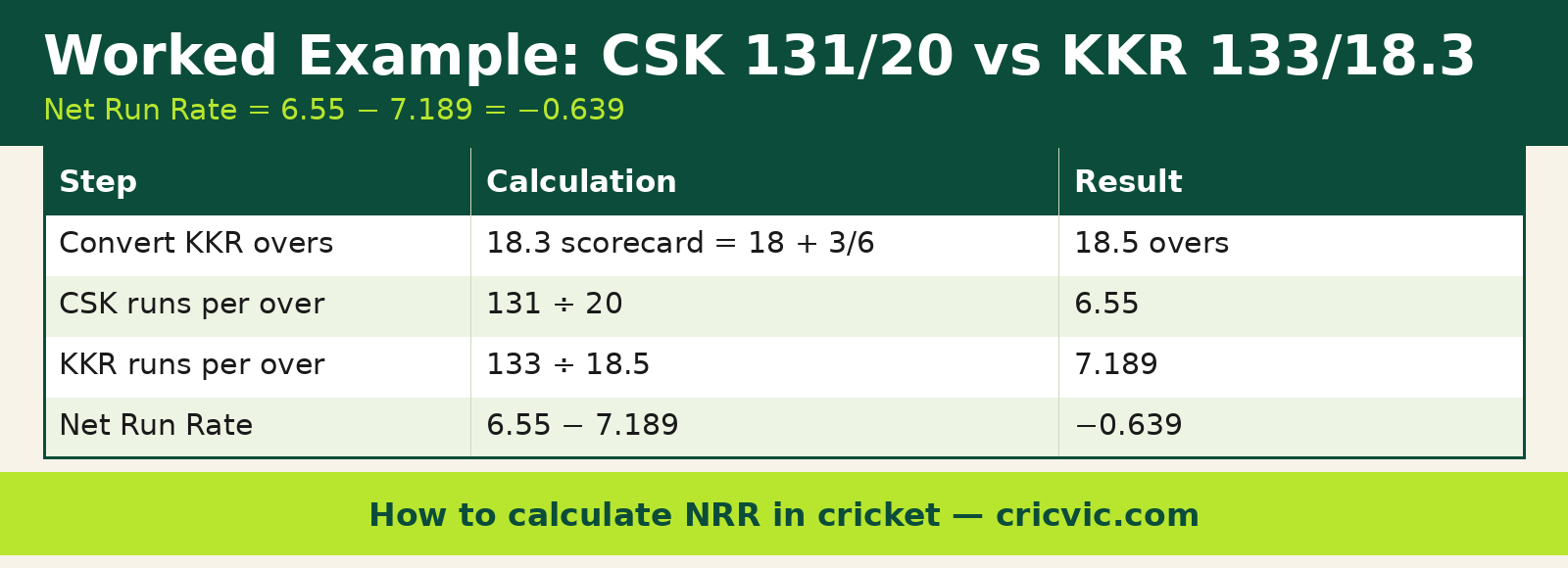
Let's calculate a real NRR using a verified match example from the IPL 2022 season: Chennai Super Kings against Kolkata Knight Riders.
· CSK: 131/5 in 20 overs
· KKR: 133/4 in 18.3 overs
Step 1 — Convert the overs. The 18.3 on the scorecard does not mean 18.3 in decimal. It means 18 overs and 3 balls, which is 18 + 3/6 = 18.5 overs. (The full conversion rule is explained in the next section.)
Step 2 — CSK's runs per over: 131 ÷ 20 = 6.55.
Step 3 — KKR's runs per over: 133 ÷ 18.5 = 7.189.
Step 4 — Subtract: 6.55 − 7.189 = −0.639.
So after this game, CSK's NRR stood at −0.639.
In a real tournament you would repeat this pooling over every completed match: add up all runs scored and all overs faced across the tournament, add up all runs conceded and all overs bowled, and run the same subtraction once.
Worked Example 2: A Three-Match Tournament (Hypothetical)
One match only shows the mechanics. NRR is pooled across a whole tournament, so let's walk through a hypothetical three-game T20 group for a team we'll call X — this also shows the all-out and chaser rules in action:
· Match 1: X 160/6 (20 overs) vs Y 140/9 (20 overs)
· Match 2: X 120 all out (18.2 overs) vs Z 121/4 (16.4 overs)
· Match 3: X 180/3 (20 overs) vs Y 150/8 (20 overs)
Step 1 — Total runs scored by X: 160 + 120 + 180 = 460.
Step 2 — Total overs faced by X: 20 + 20 + 20 = 60. Note Match 2: X were all out in 18.2 overs, so the full 20-over quota counts (the all-out rule from the next section).
Step 3 — Total runs conceded by X: 140 + 121 + 150 = 411.
Step 4 — Total overs bowled by X: 20 + 16.667 + 20 = 56.667. Note Match 2: Z chased the target in 16.4 overs (16 + 4/6 = 16.667) — the chasing side uses only the overs it actually faced.
Step 5 — Subtract: (460 ÷ 60) − (411 ÷ 56.667) = 7.667 − 7.253 = +0.414.
X's tournament NRR is +0.414. Notice how the heavy Match 2 defeat (all out for 120) drags the number down despite two wins — exactly how real NRR tables behave.
TABLE 1: Worked example — CSK 131/20 vs KKR 133/18.3
The Overs-Counting Rule: Balls, Not Decimals
This is where most NRR calculations go wrong before they even start. Scorecard notation like 17.3 counts balls in the unfinished over (0–5), not decimal tenths. You must convert balls to sixths of an over:
· .1 = +0.167 (1 ball ÷ 6)
· .2 = +0.333
· .3 = +0.500
· .4 = +0.667
· .5 = +0.833
So 17.3 overs is 17.5, 18.3 is 18.5 (never 18.3), and 19.4 is 19.667. Getting this wrong even slightly throws the whole calculation off — which is exactly why the worked example above uses 18.5 and not 18.3.
A useful mental shortcut from the same verified example: runs ÷ balls faced × 6 gives the same runs-per-over figure without any conversion at all.
The All-Out Rule
What happens when a team is bowled out before using its full overs? The ICC's official wording is unambiguous:
"In the event of a team being all out in less than its full quota of overs, the calculation of its net run rate shall be based on the full quota of overs to which it would have been entitled and not on the number of overs in which the team was dismissed."
In plain terms: being bowled out is punished. If a side is all out for 95 in 17.2 overs of a T20, its run rate for NRR purposes is 95 ÷ 20 = 4.750 — not 95 ÷ 17.333 = 5.481. Similarly, 150 all out in 35 overs of a 50-over match counts as 150 in 50 overs.
Two qualifications. The rule applies only to the dismissed side — a team that bats through its full quota uses its actual overs. And if the match itself was rain-shortened, the "full quota" is the reduced number of overs, not the original 20 or 50.
This is also the one place where wickets matter in NRR. Otherwise, losing 9 wickets or 2 makes no difference at all — only runs and overs count.
DLS, No-Results, Ties and Super Overs
Rain complicates everything in cricket, and NRR is no exception. The ICC rules here are precise:
Abandoned and no-result matches are excluded entirely. The ICC states that only matches where results are achieved count for NRR. If the game is called off, its runs and overs count for nothing.
DLS-decided matches do count, with adjustments. If Duckworth-Lewis decides a match on the par score, Team 1 is credited with Team 2's par score off the same number of overs Team 2 faced. If DLS revised the target mid-match and the game was then played out, Team 1 is credited with one run less than the final target, off the total overs allocated to Team 2. For a full explanation of how DLS targets themselves are worked out, see our DLS method explained guide.
Tied matches count like any normal match — both sides' runs and overs go into the cumulative totals. If both teams faced the same number of overs, the tie contributes zero to the difference.
Super Overs do not count toward NRR. Only the tied match itself goes into the calculation. This is confirmed in the ICC Men's T20 World Cup playing conditions.
Famous NRR Deciders
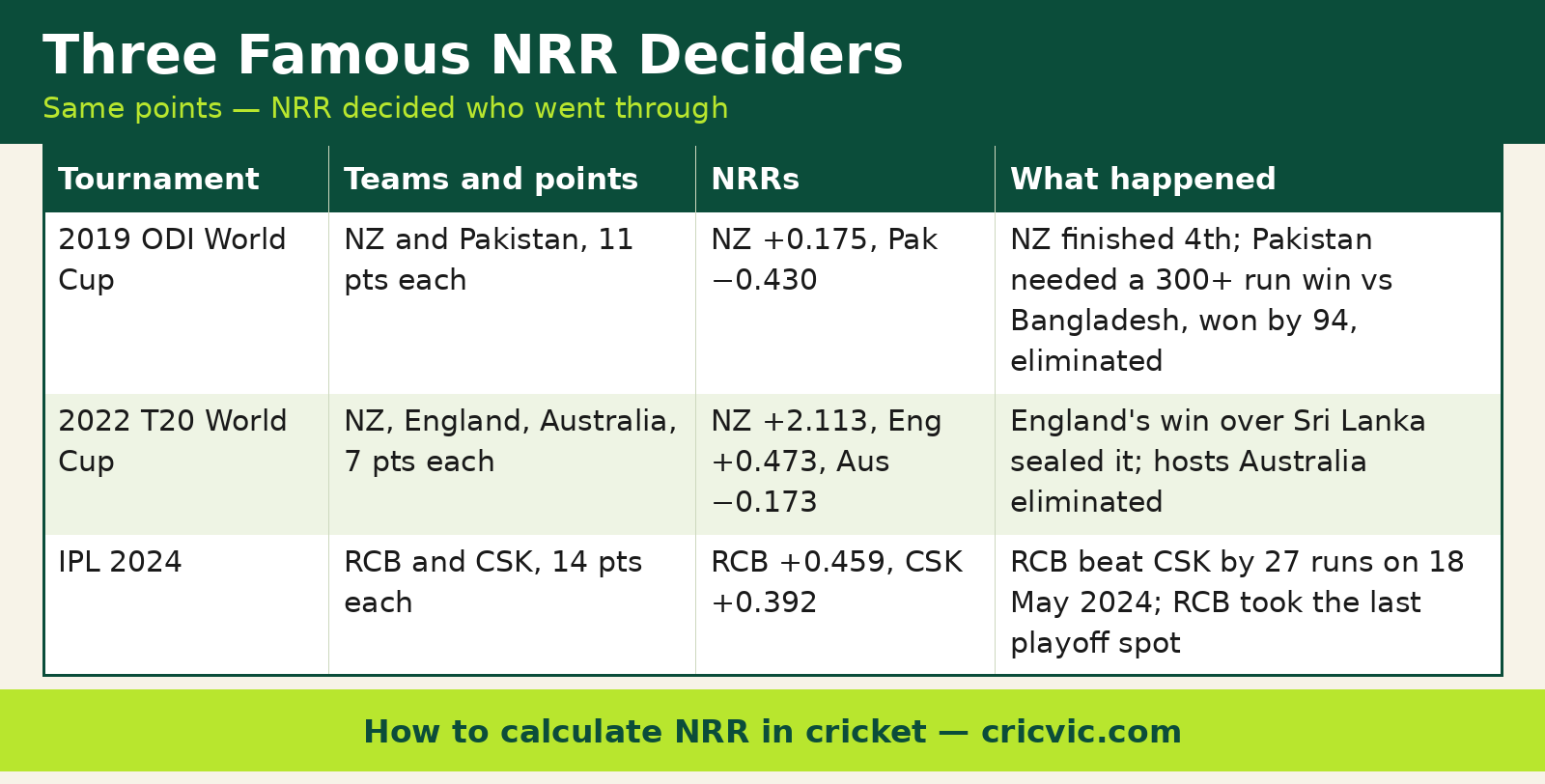
NRR is not just arithmetic — it has decided real tournaments. Here are three verified cases.
2019 ODI World Cup: Pakistan Miss Out to New Zealand
Both teams finished the group stage on 11 points from 9 matches (5 wins, 3 losses, 1 no-result each). New Zealand's NRR was +0.175; Pakistan's was −0.430. Pakistan needed to beat Bangladesh by more than 300 runs in their final game at Lord's to overtake New Zealand. They won by 94 runs — a fine victory that meant nothing — and went home. Pakistan's NRR hole traced largely back to their opening match, when West Indies bowled them out for 105 in a 7-wicket defeat.
2022 T20 World Cup: Hosts Australia Knocked Out
Super 12 Group 1 ended with three teams on 7 points: New Zealand (+2.113), England (+0.473), and Australia (−0.173). England's 4-wicket win over Sri Lanka at the SCG sealed the top two spots, and the hosts were eliminated. Australia paid for their 89-run opening defeat to New Zealand — a single heavy loss that their NRR never recovered from.
IPL 2024: RCB Edge CSK for the Last Playoff Spot
Both finished the league stage on 14 points from 14 matches. Royal Challengers Bengaluru's NRR was +0.459; Chennai Super Kings' was +0.392. The decider came on 18 May 2024 at the M. Chinnaswamy Stadium: RCB beat CSK by 27 runs (218/5 vs 191/7). CSK needed to keep the defeat to around 17–18 runs or fewer to stay ahead on NRR — they couldn't, and RCB took the final playoff place.
TABLE 2: Three famous NRR deciders
Common Mistakes
Seven misconceptions that catch even experienced fans:
1. Wickets don't matter. Except through the all-out rule, NRR only cares about runs and overs. A 9-wicket loss and a 2-wicket loss at the same run rate are identical for NRR.
2. NRR is not head-to-head. In ICC events, the tie-break order is points first, then NRR — NRR comes before head-to-head. (Some smaller tournaments order things differently, so always check the specific tournament's playing conditions.)
3. Don't average per-match NRRs. NRR is one pooled calculation over the whole tournament. Averaging match-by-match gives the wrong answer.
4. Chasers use only overs actually faced. Finishing a chase in 15 overs instead of 20 boosts NRR — the same runs go in, but fewer overs in the denominator.
5. Rain-shortened games don't vanish. Only no-result and abandoned games are excluded. DLS-decided games count, with the par-score adjustments explained above.
6. Super Overs don't count. Tied matches do; the Super Over itself doesn't.
7. Scorecard overs aren't decimals. 18.3 means 18.5, never 18.3. This single mistake ruins more NRR calculations than any other.
Calculate It Instantly — NRR Calculator
How to Read an NRR Table Mid-Tournament
During a tournament, the NRR column tells you more than just an ordering — it tells you how safe each team is. A positive NRR means a team has outscored its opponents overall; a negative one means the reverse. But the number that really matters is the gap to the nearest rival. In IPL 2024, RCB (+0.459) and CSK (+0.392) were separated by just 0.067 — roughly the value of a few extra boundaries across a season. That is why teams in the final group games don't just play to win; they play to win big or fast. Pakistan's 2019 equation — needing to beat Bangladesh by 300+ runs — shows how a deep early NRR hole can make even a final-day victory meaningless.
If you'd rather skip the manual arithmetic, our free NRR calculator does the whole pooled calculation for you — just enter each team's runs and overs, and it handles the ball-to-decimal conversion automatically. It's the fastest way to check where your team stands mid-tournament, or to work out exactly what result they need from their final group game.
FAQs
What is the formula for net run rate in cricket?
NRR = (Total Runs Scored ÷ Total Overs Faced) − (Total Runs Conceded ÷ Total Overs Bowled), calculated cumulatively across all completed tournament matches. The ICC phrases it as deducting the average runs per over scored against a team from the average runs per over scored by that team throughout the group matches.
How do you convert 17.3 overs for NRR?
17.3 on a scorecard means 17 overs and 3 balls, which converts to 17 + 3/6 = 17.5 decimal overs. Scorecard notation counts balls (0–5), not decimal tenths, so 18.3 is 18.5 and 19.4 is 19.667.
Does being all out affect NRR?
Yes. A team bowled out before its full quota is charged the full quota of overs — for example, 95 all out in 17.2 overs of a T20 counts as 95 in 20 overs. This is the only way wickets influence NRR.
Do tied matches count in NRR?
Yes — tied matches count like any other match, with both sides' runs and overs included. However, the Super Over that follows a tie does not count toward NRR.
What happens to NRR in rain-affected matches?
Abandoned and no-result matches are excluded entirely. Matches decided under DLS count, with Team 1 credited using the par-score adjustments in the ICC playing conditions.
Does NRR or head-to-head come first as a tie-breaker?
In ICC events, NRR comes first — the order is points, then NRR, then head-to-head or seeding. Pakistan's 2019 World Cup exit and Australia's 2022 T20 World Cup exit both happened because NRR, not head-to-head, was the deciding tie-breaker.
Why is NRR shown to three decimal places?
Because tournaments are genuinely decided by fractions. RCB (+0.459) beat CSK (+0.392) to the IPL 2024 playoffs by 0.067 — the equivalent of a handful of runs across a whole season. Two decimals wouldn't be precise enough to separate teams fairly.
Is NRR used in bilateral series?
No. NRR is a tournament tie-breaker for group stages and leagues. In a bilateral series the winner is decided by matches won, so NRR is neither calculated nor needed.
Conclusion
Net Run Rate looks intimidating, but it is really just two averages and a subtraction — the difficulty is in the edge cases: ball-to-decimal conversion, the all-out rule, and DLS adjustments. Master those, and you can calculate any team's NRR by hand, or check tournament tables with confidence instead of taking them on trust.
To see NRR in action in a real qualification race, read our USA cricket team schedule guide — the Americans' 2026 League 2 title run shows how cumulative results build a tournament position. For the team behind those numbers, see the USA players and squad guide. And for the rain-rule side of tournament maths, the DLS method explained pairs naturally with this guide. When you're ready to run the numbers yourself, the free NRR calculator does it in seconds.