If you have ever looked at a bowling card and wondered what does M stand for in cricket scorecard figures, the answer is simple: M stands for Maidens. It is the second number in a bowler's figures, written as O-M-R-W — overs, maidens, runs conceded, wickets taken. So 4-1-19-0 means 4 overs, 1 maiden, 19 runs, 0 wickets.
A maiden over is an over in which the bowler gives away nothing off the bat: six legal balls, no runs scored. In a game built on scoring, six balls of nothing is a real achievement — and in some formats it is genuinely rare.
One quick note: on a batting card, M can mean minutes at the crease, shown mostly in Tests. This guide is about the bowling M, which always means maidens.
Key Takeaways
M stands for Maidens — the second number in bowling figures written as O-M-R-W.
A maiden over is six legal balls with no runs scored off the bat.
Byes and leg-byes do not break a maiden; wides and no-balls do.
A wicket maiden is a maiden over in which the bowler also takes a wicket.
Maidens are routine in Tests, rare and valuable in T20 cricket, and they push a bowler's economy rate down.
Bapu Nadkarni holds the Test record: 21 consecutive maiden overs against England in Madras in 1964.
In This Article
What Is a Maiden Over?
How to Read M on a Scorecard
Byes and Leg-Byes vs Wides and No-Balls
What Is a Wicket Maiden?
Maidens in Tests vs T20
How Maidens Affect Economy Rate and NRR
Famous Maiden Records
FAQs
Conclusion
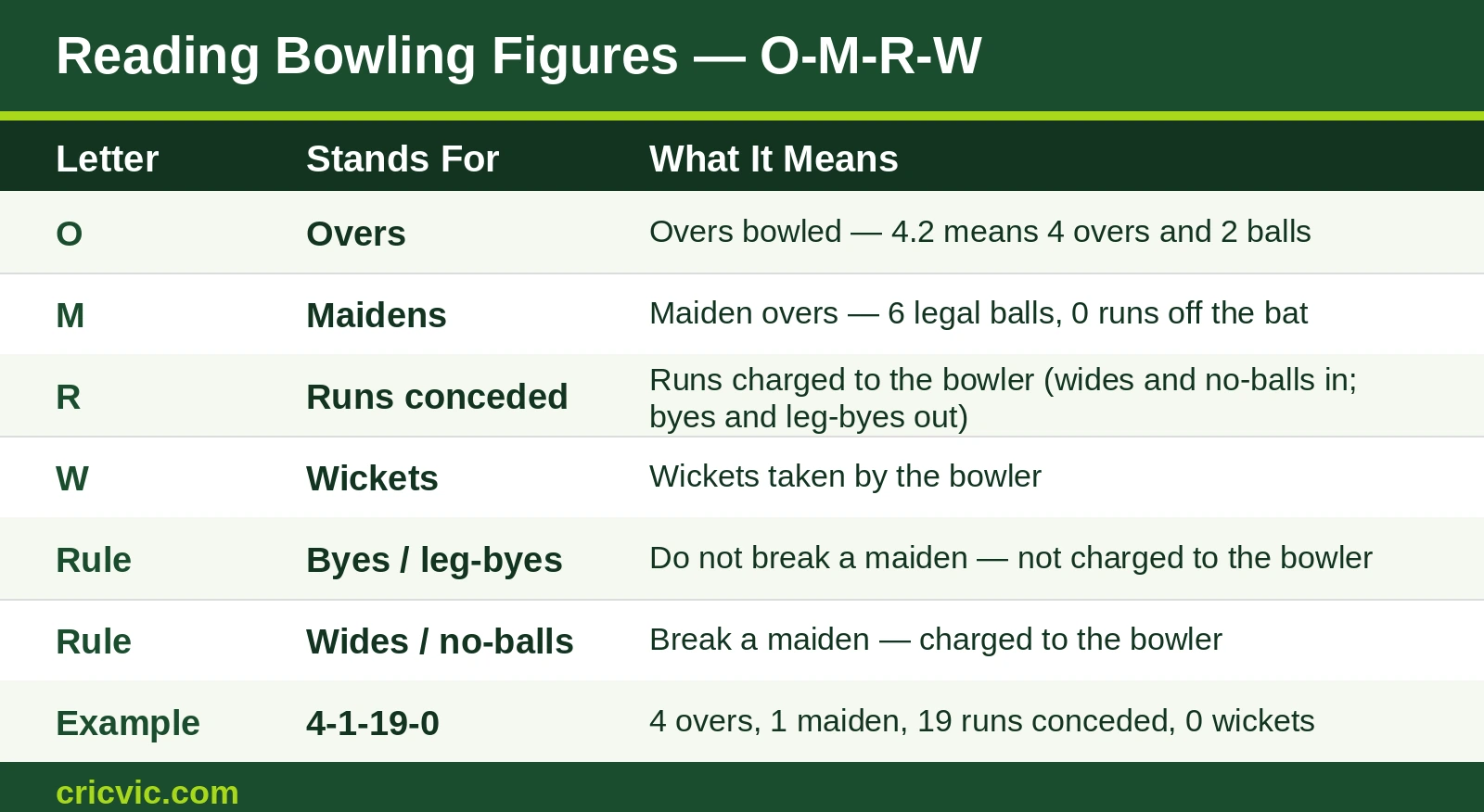
At a Glance: Reading Bowling Figures
Every bowling line follows the same pattern. Once you know the order, you can read any bowler's figures in a second.
What Is a Maiden Over?
A maiden over is an over in which the batting side scores no runs off the bat against that bowler. Six legal balls, the batters survive them without scoring, and the over ends with the scoreboard exactly where it was. Six dot balls in a row — that is all a maiden is, and it is harder than it sounds.
The word itself is old cricket language: a maiden means untouched, an over the batters could not get anything from. Bowlers aim for dot balls, and a maiden is what happens when six of them land in the same over. One loose ball and the chance is gone.
How to Read M on a Scorecard
On every scorecard, the bowling card sits below the batting card. Each bowler has a row, and the columns run in the same order everywhere: O for overs, M for maidens, R for runs conceded, W for wickets, and usually Econ for economy rate. The figures are often squeezed into one string, so 10-3-42-2 means ten overs, three maidens, 42 runs, two wickets.
Take 4-1-19-0, the example from CricVic's scorecard guide: four overs, one maiden, 19 runs, no wickets. The maiden is the most interesting number in that line — for a full over, the batters could not get him away at all.
If you are still learning to read a full scorecard, see How to Read a Cricket Scorecard: A Beginner's Guide.
Byes and Leg-Byes vs Wides and No-Balls
This is the part that confuses almost everyone. A maiden is about runs charged to the bowler, not every run on the scoreboard during the over. Some runs count against the bowler and some do not — and that decides whether the over is still a maiden.
Byes and leg-byes do not break a maiden
If the ball passes the batter without touching the bat and the batters run, those are byes. If it hits the batter's body or pads and they run, those are leg-byes. Both are extras charged to the team total, not to the bowler — so an over with only byes or leg-byes is still a maiden. The scoreboard has moved, but the bowler has conceded nothing.
Wides and no-balls do break a maiden
Wides and no-balls are different, because they are the bowler's fault. A wide is too far from the batter to reach and costs a penalty run charged to the bowler. A no-ball — an overstepped front foot or an illegal delivery — also costs a penalty run charged to the bowler, and the ball must be bowled again. Either one puts a run in the bowler's R column, and once that happens the over cannot be a maiden.
What Is a Wicket Maiden?
A wicket maiden is a maiden over in which the bowler also takes a wicket. Six legal balls, no runs off the bat, and a batter dismissed somewhere in the middle of them. It is the best over a bowler can bowl: the scoreboard does not move, the batting side loses a player, and the pressure on the next batter doubles in an instant.
Wicket maidens are why captains keep a bowler on after a maiden. A batter who has just survived six dot balls is already under pressure — tied down, with the required rate climbing or a partnership stalled — and the temptation to hit his way out grows with every ball. The scorecard does not label a wicket maiden specially; only the ball-by-ball shows the M and the W happened in the same over.
Maidens in Tests vs T20
In Test cricket, maidens are routine. Batters can afford to leave the ball, defend, and wait for a loose one, and bowlers can bowl at one spot all day. A Test innings can contain dozens of maidens. They are the background rhythm of the long game — the overs in which nothing happens, and in which everything is being set up.
In T20 cricket, a maiden is an event. Batters have 120 balls to score as many runs as they can, so leaving six balls alone is almost unthinkable. A bowler who bowls a maiden in a T20 has not just saved six runs; he has taken an over out of the innings, pushed the required rate up, and forced the batters to take risks against someone else. In a format decided by a handful of runs, a maiden can be the over that wins the match.
Why the gap is so wide
It comes down to what each format rewards. A Test batter is rewarded for survival, so he can play a maiden out without it hurting him. A T20 batter is punished for every dot ball, because the balls are limited and the runs are the whole point. One-day cricket sits in between: a maiden early on can set the tone for an innings.
How Maidens Affect Economy Rate and NRR
A maiden is worth more than the runs it saves. A bowler's economy rate is his runs conceded divided by his overs bowled, so an over that costs nothing pulls the average down fast. Bowl maidens regularly, and the economy rate takes care of itself.
The effect goes beyond one bowler's figures. Maidens build pressure: a batter who cannot score starts to take risks, risks bring wickets, and wickets bring more maidens, because a new batter takes time to settle. That is why captains love a bowler who can string dot balls together.
Net run rate: The same pressure shows up in net run rate, the tiebreaker that decides so many league tables. A team that bowls maidens concedes fewer runs per over, and a team that faces maidens scores fewer runs per over — both move its net run rate in the right direction. The maths is a guide of its own, so we will not re-derive it here.
For the full formula, worked examples and rules, see How to Calculate NRR in Cricket.
Watch them live on the live cricket scores page, which carries ball-by-ball scores so you can see a maiden building dot by dot.
Famous Maiden Records
The most famous maiden record belongs to Bapu Nadkarni, India's left-arm spinner, and it has stood for more than sixty years. Against England in Madras on 12 January 1964, Nadkarni bowled 21 consecutive maiden overs — 131 balls in a row without conceding a run. At the end of the third day his figures read 29-26-3-0. He finished the match with 32-27-5-0.
What makes it so remarkable is the patience on both sides. England's Brian Bolus and Ken Barrington refused to score off him, playing ball after ball dead at their feet, and Nadkarni refused to give them anything to hit. In six-ball overs, it remains the Test record for the most consecutive maidens.
Other maiden landmarks
The record for the most consecutive balls without conceding a run belongs to Hugh Tayfield of South Africa: 137 dot balls, or 16 eight-ball overs, against England at Durban in 1956-57. In first-class cricket, Nadkarni sits third on that list, behind Tayfield and Manish Majithia of Madhya Pradesh (136 dot balls in a row against Railways in 1999-2000). Nadkarni finished his Test career with an economy rate of 1.67, one of the most economical in the game.
FAQs
Can a maiden over include byes?
Yes. Byes and leg-byes are not charged to the bowler, so an over with only byes or leg-byes is still a maiden, even though the team total goes up.
Can a wicket fall in a maiden over?
Yes — that is a wicket maiden: the batter is dismissed, no runs are scored off the bat, and the over counts as a maiden.
Why are maidens so rare in T20 cricket?
Because T20 batters cannot afford dot balls. With only 120 balls in an innings, leaving six unscored pushes the required rate up sharply, so batters take risks — and that makes a T20 maiden genuinely remarkable.
What does M mean on a batting card?
On a batting card, mostly in Tests, M can mean minutes at the crease — how long the batter spent batting. It is a different M from the bowling M, which always means maidens.
Conclusion
So the next time you see M on a scorecard, you will know what you are looking at: maidens, the overs in which a bowler gave the batters nothing. Watch for them on the live scores — in a Test they are the rhythm of the day, and in a T20 they might be the over that decides the match.
Last verified: 20 November 2026