If you have ever wondered how to calculate strike rate in cricket, the answer is one short division. For a batter, strike rate is runs scored per 100 balls faced: divide the runs by the balls faced and multiply by 100. For a bowler, it is balls bowled divided by wickets taken — no multiplication.
The two numbers look similar on a scorecard but mean opposite things. A batter wants a high strike rate, because it means fast scoring. A bowler wants a low one, because it means quick wickets.
Below are both formulas, worked examples, what counts as a good strike rate in each format, and the record innings that show how fast batting can get.
Key Takeaways
Batting strike rate = (runs scored ÷ balls faced) × 100. Higher is better.
Bowling strike rate = balls bowled ÷ wickets taken. Lower is better.
Only legal deliveries count as balls faced — wides and no-balls do not count for the batter.
A strike rate of 150 means 1.5 runs per ball; a bowling strike rate of 24 means a wicket every 24 balls.
The highest strike rate in a T20I innings is 520.00 — Dipendra Singh Airee, 52* off 10 balls vs Mongolia in 2023.
In This Article
Batting Strike Rate Formula
Bowling Strike Rate Formula
How to Read SR on a Scorecard
What Is a Good Strike Rate?
Strike Rate vs Batting Average
Strike Rate, Economy Rate and NRR
Famous Strike Rate Records
FAQs
Conclusion
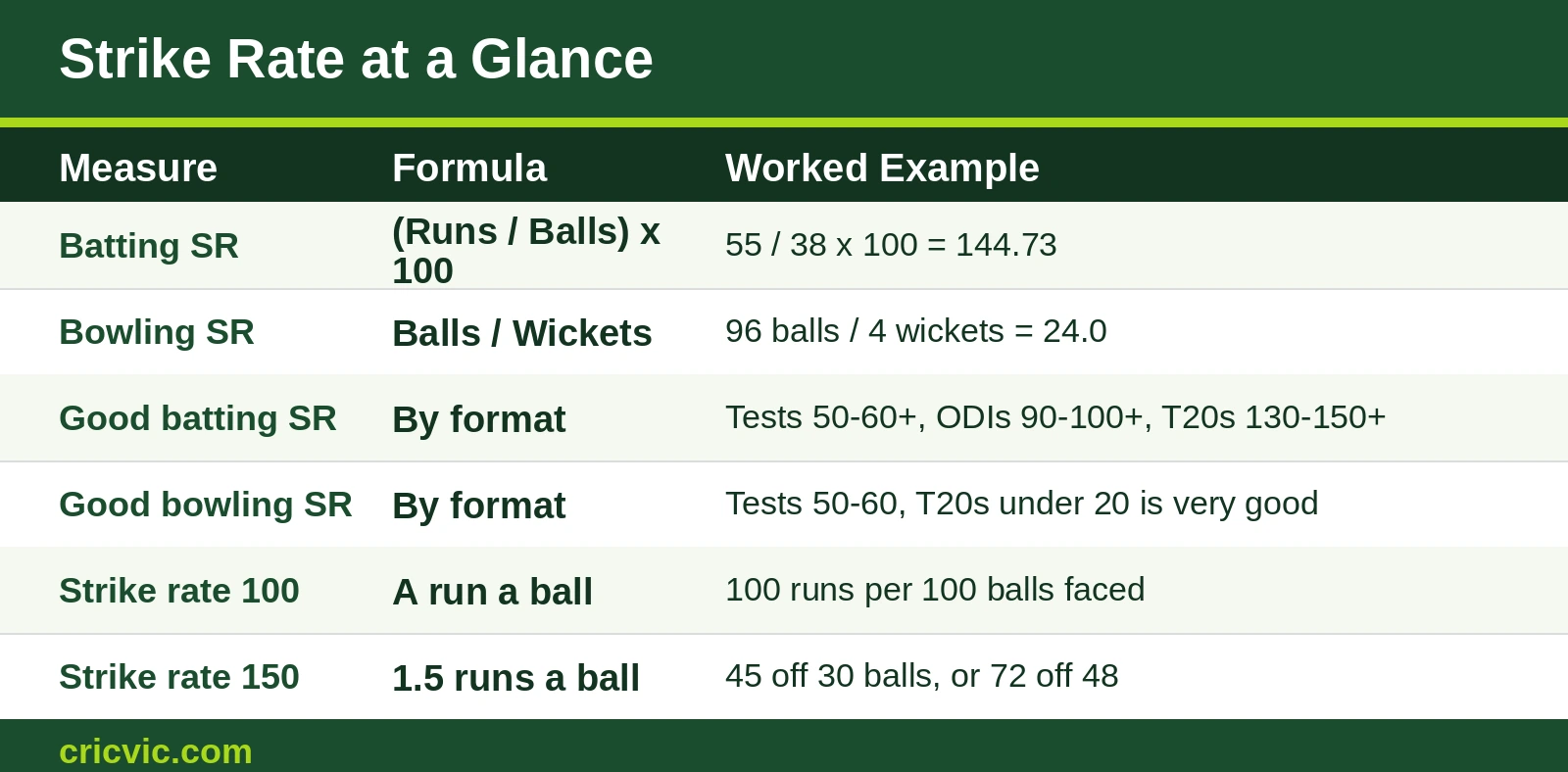
At a Glance: Strike Rate in One Table
Both formulas, side by side, with a worked example for each.
Batting Strike Rate Formula
A batter's strike rate answers one question: how fast does he score? The formula is strike rate = (runs scored ÷ balls faced) × 100. The × 100 turns the answer into runs per 100 balls, which is why a strike rate of 100 means exactly a run a ball, and 150 means one and a half runs a ball.
Only legal deliveries count as balls faced. A wide or a no-ball does not go into the batter's ball count, even if its runs count in the team total — the detail that hand-calculated strike rates come out slightly off.
Worked examples
Take Fakhar Zaman's 55 not out off 38 balls, from CricVic's scorecard guide: 55 ÷ 38 = 1.447, × 100 = 144.73 — nearly one and a half runs per ball, a strong T20 innings. Simpler numbers work the same way: 45 off 30 is 150.00, and so is 72 off 48.
Bowling Strike Rate Formula
A bowler's strike rate answers a different question: how quickly does he take wickets? The formula is strike rate = balls bowled ÷ wickets taken. There is no × 100 and no percentage — the answer is simply a count of deliveries. A strike rate of 24 means a wicket every 24 balls on average, one wicket every four overs.
Two quick examples: 96 balls and 4 wickets is 96 ÷ 4 = 24.0 balls per wicket; 276 balls for 13 wickets is 276 ÷ 13 = 21.23. The second bowler strikes slightly more often.
Bowling strike rate sits beside two other numbers, and the three are tied together exactly: bowling average = economy rate × strike rate ÷ 6. Average is runs per wicket, economy is runs per over. A bowler who takes wickets quickly can afford to be a little expensive, and one who never goes for runs can afford to strike slowly.
How to Read SR on a Scorecard
On a scorecard, SR sits in the batting card, next to each batter's runs, balls faced, fours and sixes. It is always the batting strike rate — runs per 100 balls — so a batter on 55 off 38 will show SR 144.73. A not-out batter's strike rate is calculated the same way; the asterisk after his runs changes nothing.
The bowling card does not usually show a bowling strike rate column. Instead it shows O-M-R-W — overs, maidens, runs conceded and wickets — and you work it out yourself: overs × 6 gives the balls, divided by the wickets. A line of 10-1-42-3 is 60 balls for 3 wickets, a bowling strike rate of 20.0.
If the rest of the scorecard still looks like alphabet soup, see How to Read a Cricket Scorecard: A Beginner's Guide, which explains every column, and the maiden guide,
For the M column in those bowling figures, see What Does M Stand for in Cricket Scorecard?.
What Is a Good Strike Rate?
A good strike rate depends on the format, because each format asks a different job of the batter. These are general benchmarks, not records — role and match situation matter as much as the number.
Batting: good strike rates by format
In Tests, where survival matters most, 50-60 or more is brisk — most Test batters sit in the 40s and 50s, and anything above 60 is genuinely fast for the long game. In ODIs, 90-100 or more is strong, and the best finishers push past 110. In T20s, 130-150 or more is strong, and above 170 is exceptional; only a handful of batters sustain that over a career.
Bowling: good strike rates by format
For bowlers the scale runs the other way. In Tests, 50-60 balls per wicket is solid — a wicket every eight to ten overs. In T20s, where a bowler only gets 24 balls in a match, a strike rate under 20 is very good. In ODIs the middle ground applies, with the best strike bowlers in the mid-20s to low-30s.
Strike Rate vs Batting Average
Strike rate and batting average measure different things, and neither tells the full story alone. Average is runs divided by times dismissed — not-outs excluded — so it measures consistency. Strike rate measures pace: how quickly the runs come.
That is why the same two numbers can describe very different players. An anchor can average 50 with a strike rate of 70, holding an innings together while others hit around him. A finisher can average 30 with a strike rate of 160, winning games in twenty balls and failing plenty of times too. Look at only one of the two and you will misjudge both of them.
Strike Rate, Economy Rate and NRR
Strike rate does not live in isolation. A batting side with high strike rates scores quickly, which lifts its run rate — and run rate is half of net run rate. A bowling side that strikes quickly takes wickets, which slows the opposition down and, with a low economy rate, pushes its own net run rate up. That is why a single explosive innings can change a whole tournament table, not just one match.
The link runs both ways. A bowler with a low strike rate but a high economy rate takes wickets and leaks runs at the same time, and the two effects partly cancel out. One with a high strike rate and a low economy rate is the bowler captains trust in the big moments.
For the full formula, worked examples and rules, see How to Calculate NRR in Cricket.
Watch strike rates move live on the live cricket scores page, which carries ball-by-ball scores for every match.
Famous Strike Rate Records
The highest strike rate in a T20I innings belongs to Nepal's Dipendra Singh Airee: 52 not out off just 10 balls, a strike rate of 520.00, against Mongolia at Hangzhou on 27 September 2023, in the Asian Games. He reached his fifty off nine balls — the fastest fifty in T20I cricket — hitting eight sixes and no fours. The maths checks out: 52 ÷ 10 × 100 really is 520.
Among full-member batters, the highest is Harry Brook's 31 not out off 7 balls, a strike rate of 442.85, for England against West Indies at St George's on 16 December 2023. The most famous high strike-rate innings is older: Yuvraj Singh's 58 off 16 balls, a strike rate of 362.50, for India against England at Durban on 19 September 2007, in the first T20 World Cup — the innings with six in one Stuart Broad over.
Why small innings top the list
Notice that every record above is a short innings — it is far easier to strike at 400-plus for seven balls than for seventy. The longer a batter stays in, the more his strike rate settles towards normal. Check the balls faced first: a 520 off ten balls is a remarkable cameo, not a career rate.
FAQs
Is strike rate a percentage?
No. Batting strike rate is runs per 100 balls faced, so it can go above 100 — 150 simply means 1.5 runs per ball.
Why is a lower bowling strike rate better?
Because bowling strike rate is balls per wicket. A lower number means fewer balls between wickets, so the bowler strikes more often. A strike rate of 20 beats one of 40.
Can a bowling strike rate be 0?
No. A bowler who has taken no wickets has no strike rate at all — you cannot divide by zero. Scorecards show a dash instead, and the figure only appears once he takes his first wicket.
Does a not-out innings change the strike rate?
No. A not-out batter's strike rate is calculated the same way: runs divided by balls faced, times 100. The not-out only matters for his batting average, where it does not count as a dismissal.
Conclusion
Strike rate is one short calculation with two opposite meanings: runs per 100 balls for a batter, where higher is better, and balls per wicket for a bowler, where lower is better. Learn both formulas, check them against a scorecard, and the SR column will stop being a mystery.
Last verified: 21 November 2026